Why Progress Gets Stuck
Medicine reveals why scientific knowledge does not automatically become affordable, scalable improvements in everyday life.
Medicine, incentives, and the institutions that turn knowledge into impact
There is a peculiar feature of modern life: we live inside astonishing technological progress and yet often experience the world as frustratingly slow. New scientific tools arrive every year, computing power expands, and laboratories can measure things that were invisible a generation ago. Still, many diseases remain untreatable, clinical development remains expensive, and some valuable innovations take decades to reach the people who need them.
Saloni Dattani’s essay “Every Disease Is a Policy Failure,” published by Works in Progress on August 11, 2026, offers a useful way to think about this puzzle. The essay is about medicine, but its deeper subject is institutional conversion: how societies turn knowledge into reliable, scalable improvements in human life.
1. Progress is not a discovery; it is a chain
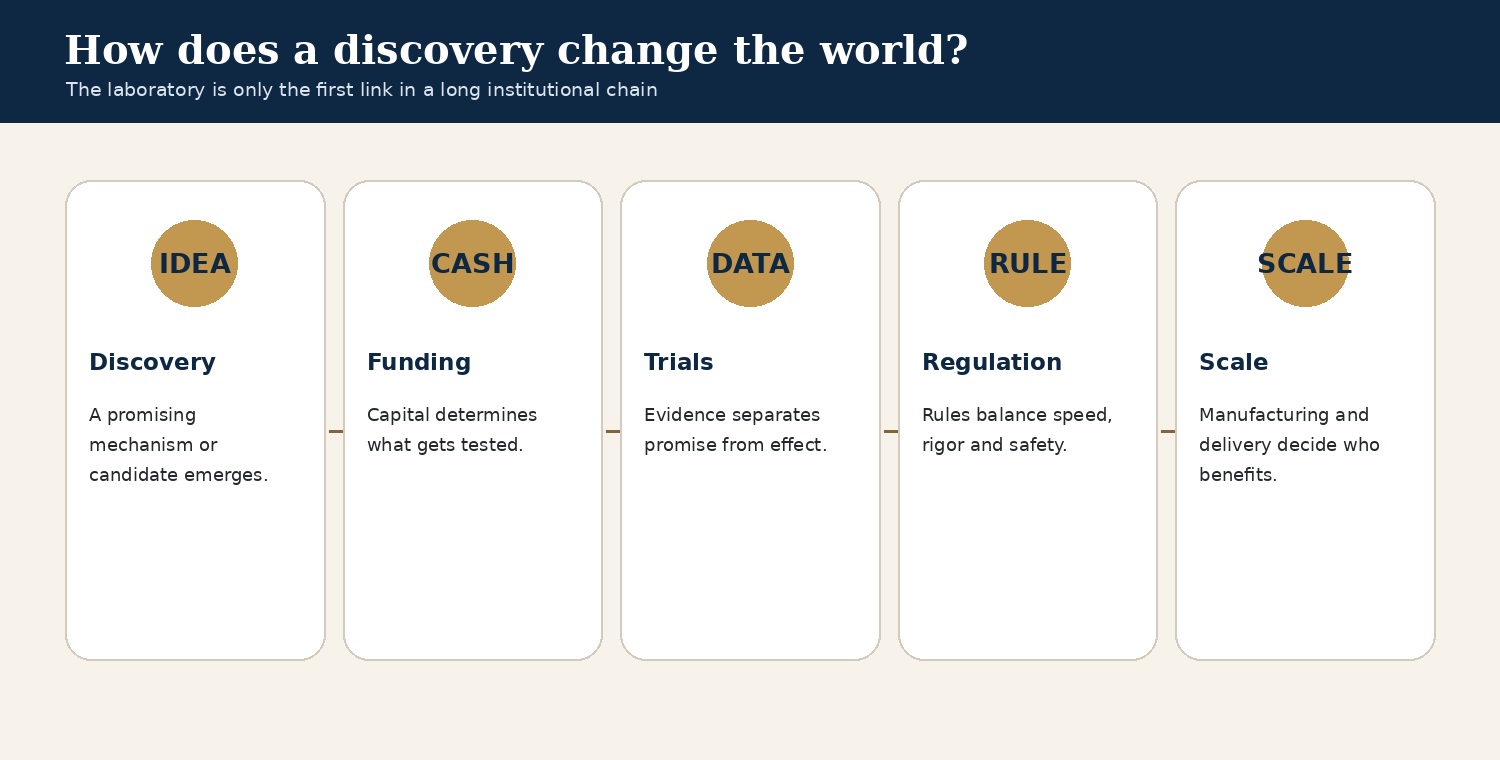
The popular story of innovation is compressed. A scientist makes a discovery, a company develops a product, and society benefits. In reality, discovery is merely the first link. A promising idea must attract capital, survive testing, pass regulatory scrutiny, be manufactured consistently, move through distribution networks, and reach users at a price they can afford.
This distinction matters because a society can be excellent at producing knowledge and poor at converting that knowledge into outcomes. The missing capability is not always scientific. It may be financial, organizational, regulatory, or logistical.
2. Social value and market value are different quantities
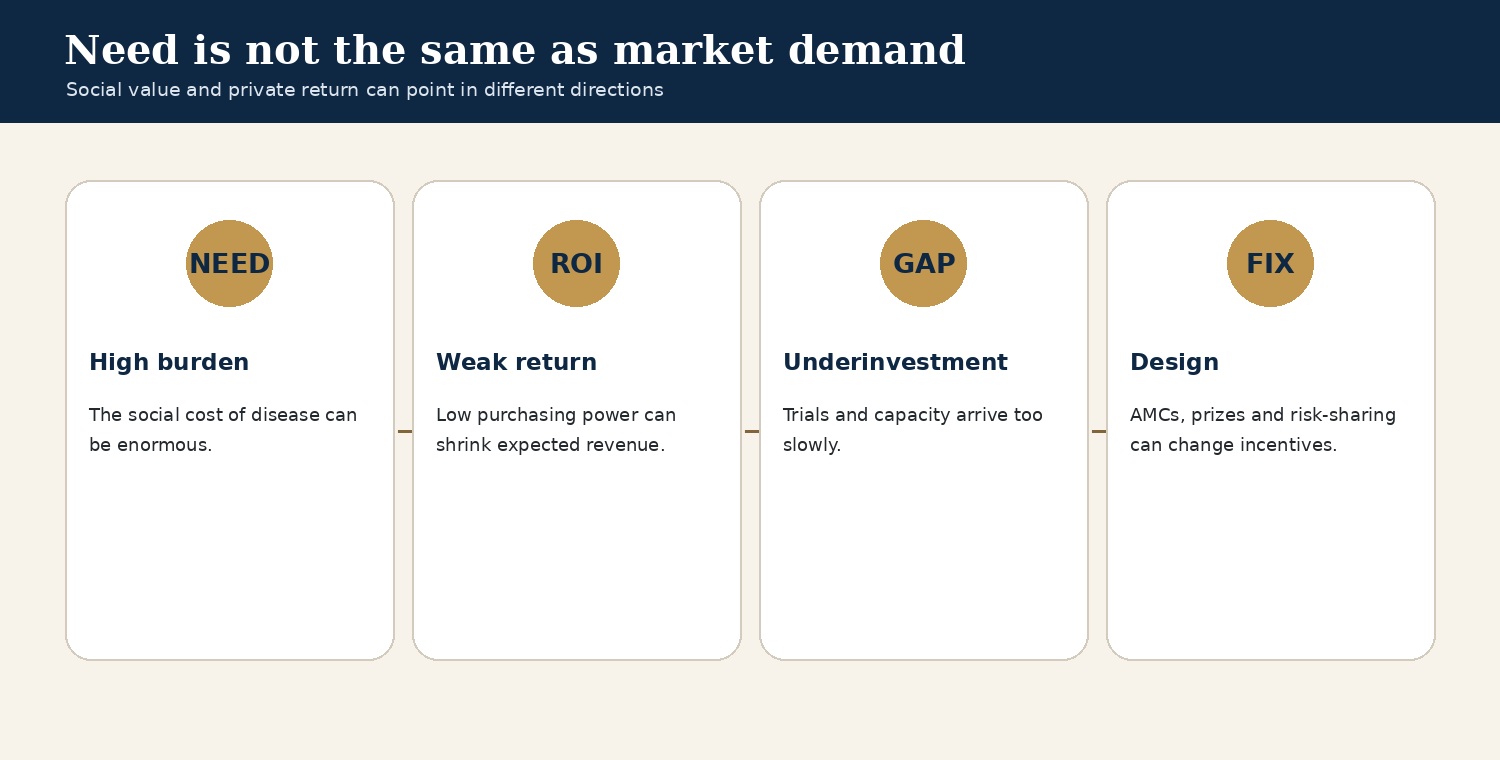
One of the essay’s most important ideas is that the burden of a disease and the commercial value of treating it can diverge sharply. A condition may impose enormous suffering while affecting populations with little purchasing power. In such cases, the social return to innovation can be high even when the private return is weak.
This is why tropical and rare diseases are so revealing. Underinvestment does not necessarily mean that firms are irrational or indifferent. It may simply mean that the expected reward is too small relative to the cost and risk of development. If the rules remain unchanged, individually rational decisions can produce a collectively poor outcome.
3. Institutions matter because incentives matter
Researchers respond to grants and publication incentives. Firms respond to expected profits and failure risk. Investors compare returns across opportunities. Regulators are rewarded for avoiding catastrophic mistakes. Governments face budget constraints. Patients want speed and access. Each actor can behave rationally while the system as a whole remains slow.
Institutional design changes the environment in which those choices are made. It determines who bears risk, who captures upside, what evidence is required, what counts as success, and how much certainty exists about future demand. In this sense, institutions are not background conditions. They are active technologies for coordinating human behavior.
4. Advance market commitments show how policy can shape expectations
An advance market commitment is an elegant example. Donors or governments promise in advance to purchase a product if it meets specified standards. The payment is conditional on success, but the promise changes the expected size and credibility of the future market.
That is different from simply subsidizing a company. The public sector is not picking a winner or manufacturing the product itself. It is making demand more predictable. A well-designed commitment can therefore unlock private investment while preserving competition over who can meet the target most effectively.
5. Better science can coexist with slower development
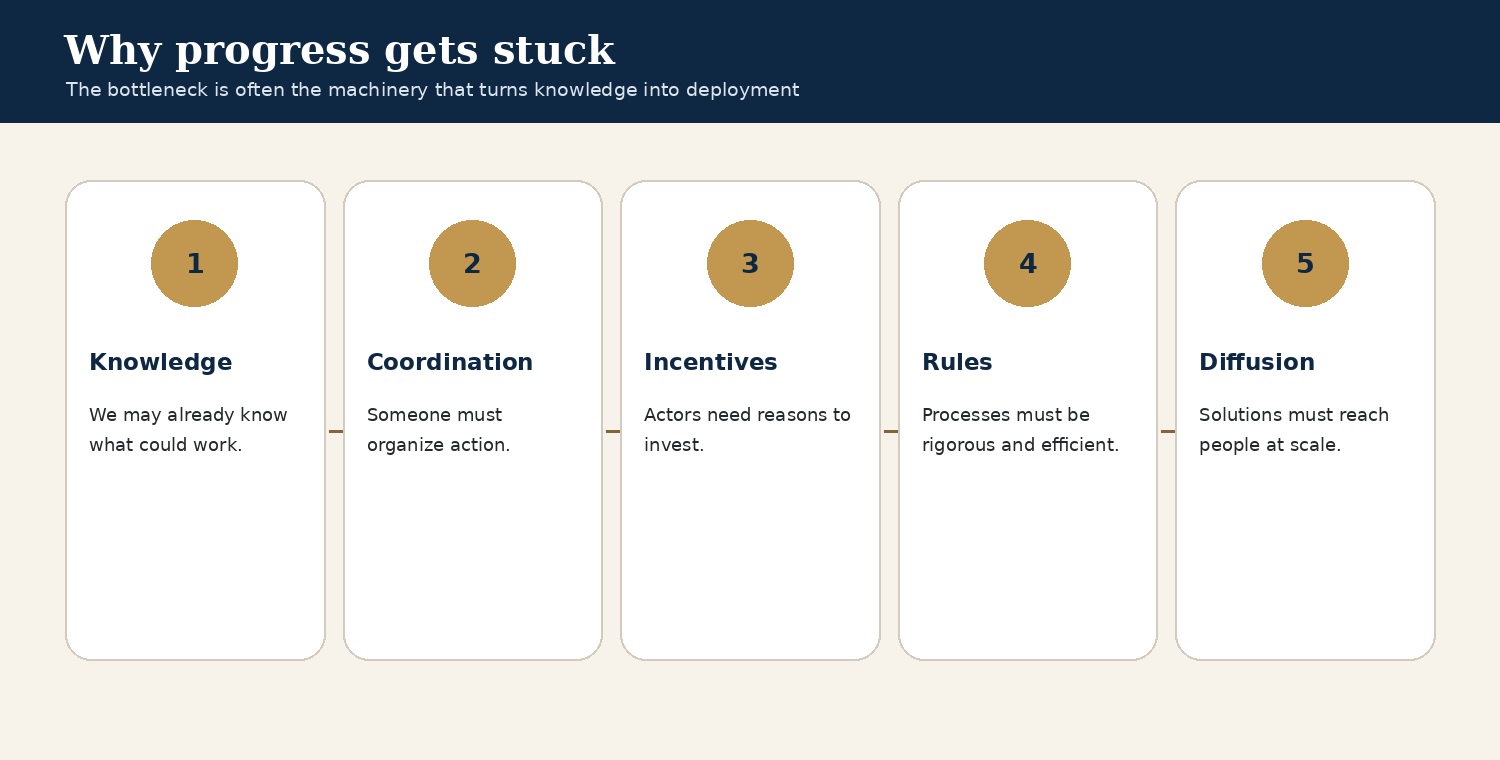
The modern scientific toolkit has improved dramatically. Sequencing is cheaper, imaging is more precise, and biological design is more powerful. Yet drug development remains slow and costly. Part of the explanation is scientific: the easiest problems have already been solved. But part of it is institutional inertia.
Clinical development sits inside a dense layer of contracts, ethics review, recruitment systems, monitoring practices, data checks, and regulatory expectations. Many of these layers are essential. But processes can also accumulate defensively, persisting long after their marginal value has declined. The challenge is not to remove rigor, but to redesign the system so that rigor and speed reinforce one another.
6. The broader lesson: societies differ in their conversion rate
The essay’s framework travels far beyond medicine. Energy technologies can be technically viable but blocked by permitting and grid constraints. Housing can be physically buildable but institutionally scarce. Educational interventions can be evidence-based but difficult to scale. Infrastructure can have positive social returns but weak financing structures.
In all of these cases, the central question is not simply whether a solution exists. It is whether a society has built the institutions required to move from knowledge to action. That capacity—the conversion rate from ideas to outcomes—may be one of the most important forms of state and social capability.
7. Why this matters for how we read the world
News encourages us to focus on events: a drug approval, a scientific breakthrough, a budget cut, a new regulation. A better analytical habit is to ask what system sits underneath the event. Who has the incentive to act? Who bears the risk? Where does coordination fail? Which part of the chain is slowest?
Those questions reveal why some societies diffuse useful ideas quickly while others allow them to stall. Progress is never automatic. It is produced by a combination of knowledge, incentives, institutions, and execution.
The world is not short of knowledge. It is short of systems that reliably turn knowledge into impact.
8. From Discovery to Daily Life: The Invisible Last Mile
A scientific discovery can be dated. Diffusion cannot. That difference distorts how we tell stories about progress. The paper, patent or laboratory result becomes the dramatic moment, while the years of trials, contracting, regulatory review, manufacturing, procurement and distribution disappear into the background. Yet those supposedly mundane steps determine whether a discovery changes millions of lives or remains a promising result known mainly to specialists. The last mile is therefore not a minor implementation detail. It is part of the innovation system itself. A society that produces brilliant discoveries but cannot test, finance, approve and scale them efficiently will experience progress more slowly than its scientific capacity would suggest.
9. Need Is Not Demand
Markets measure willingness and ability to pay; they do not directly measure suffering. That distinction matters enormously in medicine. A disease can impose a vast social burden and still generate a weak commercial opportunity if the people affected are poor, geographically fragmented or too few to support conventional development economics. This is not adequately explained by condemning profit. Drug development is expensive and uncertain, and a system that cannot reward successful risk-taking will eventually produce less innovation. The more useful policy question is how to redesign expected returns so that solving a high-social-value problem can also become a viable investment.
10. Creating Markets Without Choosing Winners
Advance market commitments are powerful because they separate two decisions that governments often combine. The public sector defines the outcome it values and commits purchasing power if that outcome is achieved, but it does not have to predict in advance which company or technical pathway will succeed. That preserves competition while reducing demand uncertainty. It also illustrates a broader form of state capacity: governments can organize demand, share risk and set standards without becoming the sole producer. Sometimes the most effective intervention is not to replace markets but to make a socially valuable market credible enough to exist.
11. Regulation Is a Productivity Problem
Debates about regulation are often framed as a choice between speed and safety. That framing is too crude. The better question is how much useful information and risk reduction each requirement produces relative to the time and resources it consumes. Strong institutions are not those with the most procedures. They are institutions capable of learning which procedures remain valuable, which have become redundant, and how to concentrate scrutiny where the stakes are highest. Regulatory reform, at its best, is an exercise in institutional productivity rather than deregulation for its own sake.
12. Institutions Are Technologies Too
Platform trials make the point especially clearly. Instead of rebuilding the organizational machinery of a clinical trial for every candidate treatment, a persistent platform can share recruitment channels, data systems, control groups and administrative infrastructure. Treatments can enter and leave as evidence accumulates. This is innovation in organization rather than molecules. The distinction matters because modern economies routinely celebrate technological invention while underestimating the productivity gains available from better institutions. Procurement systems, permitting processes, trial designs and standards can all be technologies in the functional sense: repeatable methods that allow society to accomplish more with the same resources.
13. Beyond Medicine: Housing, Energy and Education
Housing, energy and education reveal the same structure. We may know how to build dense housing, yet zoning and permitting prevent supply. We may possess reliable low-carbon technologies, yet grid connections, financing and construction approvals delay deployment. We may know that a teaching practice works, yet lack the organizational capacity to reproduce it across thousands of schools. Technical feasibility is only the first gate. Institutional, economic and organizational feasibility come after it. Many bottlenecks in advanced societies arise not because nobody knows what to do, but because too many actors must coordinate under rules that were not designed for the new possibility.
Conclusion | Progress Is Made, Not Given
The deepest lesson is that progress is not an automatic consequence of accumulating knowledge. Knowledge creates possibilities. Institutions determine how quickly those possibilities become ordinary life. That changes the questions worth asking. When a valuable technology remains absent, we should not only ask whether the science is ready. We should ask who bears the risk, who captures the reward, which approvals are necessary, whether demand is credible, whether infrastructure can scale, and whether failed approaches can exit quickly. A society’s capacity for progress may therefore be measured less by how many answers it discovers than by how effectively it converts answers into reality.
Source note
Saloni Dattani, “Every Disease Is a Policy Failure,” Works in Progress, August 11, 2026. The original article is free to read at worksinprogress.co/issue/future-of-medicine/. This document is an original bilingual adaptation and commentary, not a translation or reproduction of the source essay.

How Singapore Governs
How parliamentary government, professional administration, open markets, fiscal rules, compulsory savings and public housing reinforce one another.

Singapore: From Strait Port to Global City-State
How a small island converted location into connectivity—and connectivity into state capacity.

An Economic History of France
How France evolved from an agrarian kingdom into a modern economy through royal finance, revolution, industrialization, state planning, welfare, and high-value industry.