How Can the French Work Less and Still Afford Generous Welfare?
How the French model exchanges a large share of private income for collective security—and why ageing, weak growth and public debt are making that bargain more expensive.
France often looks puzzling from the outside. The legal benchmark for a full-time workweek is 35 hours, paid holidays are treated as a normal part of life, and attempts to extend working lives can trigger nationwide political conflict. At the same time, France runs one of the largest welfare states in the developed world.
The apparent contradiction becomes sharper when the fiscal side is added. In 2025, compulsory levies amounted to about 43.6% of GDP, while public expenditure reached 57.2% of GDP. Social-protection benefits alone were equivalent to about 31.9% of GDP in 2024.
So the useful question is not whether the French have somehow discovered a way to work less and receive more for free. They have not. The real question is how a society can deliberately exchange a large share of private income for collective security — and what economic conditions are required to make that bargain sustainable.
The French model is best understood as a social contract built around four linked ideas: high productivity, broad taxation, social insurance and strong protection of non-work time. Its strength is that it reduces the amount of life risk each household must carry alone. Its weakness is that the system becomes extremely expensive when productivity slows, the population ages and public debt rises.
1. The 35-hour week does not mean nobody works beyond 35 hours
France’s 35-hour rule is a legal benchmark for normal full-time working time, not a hard ceiling. Employees can and do work longer. The important institutional point is that hours beyond the benchmark must be treated as additional labour — through overtime pay, compensatory time or working-time arrangements negotiated under French law.
This changes the default assumption about time. The 36th hour is not simply absorbed into the job; it has to be accounted for. The rule therefore says something deeper about the French labour contract: an employee sells a defined portion of time, not unlimited availability.
France also does not have Europe’s very shortest working hours. OECD basic statistics in its 2026 survey put average annual hours worked in France at roughly 1,498 hours. The more important question is why an advanced economy can sustain relatively short annual hours without becoming poor. The answer begins with productivity — the amount of value produced per hour.
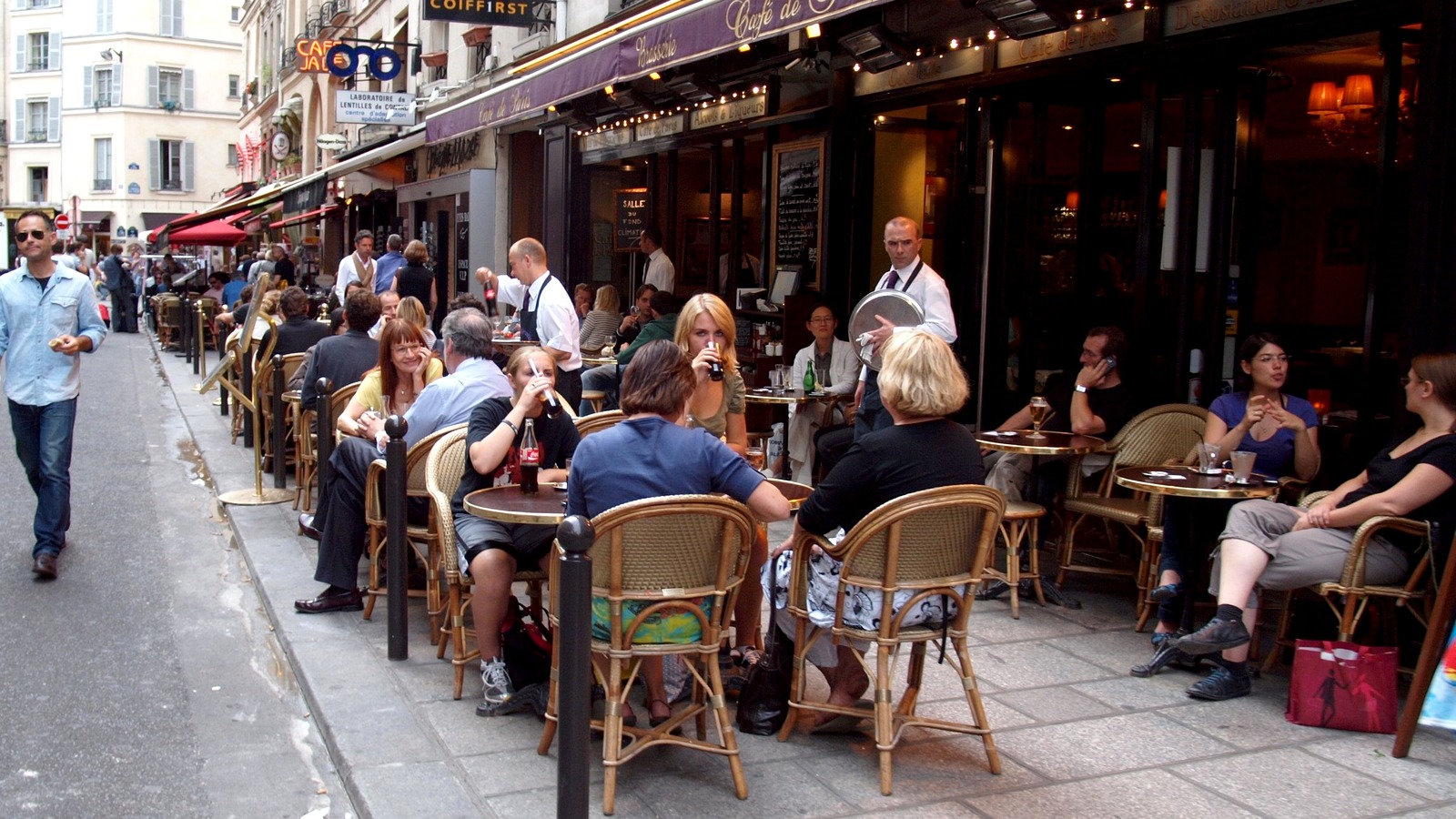
A café terrace in Paris. In the French model, time outside work is not merely private preference; it is reinforced by institutions. · Wikimedia Commons · CC BY 2.0
2. Welfare is not mainly about ‘the government giving people money’
The simplest way to understand the French welfare state is as a giant risk-pooling mechanism. Illness, unemployment, disability, old age and the cost of raising children are large and uncertain risks. If households must carry them entirely on their own, they need to build much larger precautionary savings and private insurance buffers.
France socialises a significant part of those risks. Workers contribute while employed and draw benefits when they are sick, unemployed or retired. Families with different levels of income and different life circumstances share the costs of health care, pensions and family policy through taxes and social contributions.
That is why the scale is so large. Eurostat estimates social-protection benefits in France at around 31.9% of GDP in 2024, one of the highest shares in the European Union. The state is not simply ‘supporting people’; it is administering an enormous national insurance system.

French physicians at work. Social protection is better understood as collective risk pooling than as simple cash redistribution. · Wikimedia Commons · CC BY-SA 4.0
3. High taxes buy something very specific: lower private uncertainty
A high-tax society gives households less disposable cash today. But the comparison is incomplete unless we also count what households do not have to finance privately to the same extent: health insurance, education, unemployment protection, parts of childcare and housing support, and a substantial public pension system.
This does not make taxes pleasant, and French voters complain about them just as voters elsewhere do. But economically, part of the tax burden can be understood as compulsory social insurance. The system forces households to pre-purchase a degree of security collectively rather than asking each family to self-insure against every major life risk.
The underlying bargain is straightforward: less freedom over part of today’s income in exchange for more predictability over tomorrow’s life.
4. Why does that make people more willing to protect leisure time?
People often work long hours not only because they want more consumption but because they fear falling. The fear of losing health coverage, becoming unemployed, reaching old age without sufficient savings or facing an unaffordable family shock can make workers highly dependent on continuous income.
When part of those risks is socialised, the worker’s outside option improves. Losing a job is still painful, but it does not necessarily mean immediate collapse. A serious illness is still frightening, but it does not carry the same direct financial risk. Retirement is understood not only as personal savings but as a right accumulated through decades of contributions.
That is why working time and retirement age become moral and political questions, not merely technical ones. Governments see actuarial parameters; citizens often see years of their lives.
5. Redistribution is not designed to make everyone equal
France allows markets to generate unequal incomes and then performs a large second-stage redistribution through taxes, cash transfers and public services. The objective is not literal equality of income. It is to prevent a market setback from becoming a complete collapse in living standards.
A person can lose a job without immediately losing access to health care. A low-income child can still enter the public education system. A severe illness should not require a household to pay the full market price of treatment out of pocket. In that sense, the French model draws a floor under social failure.
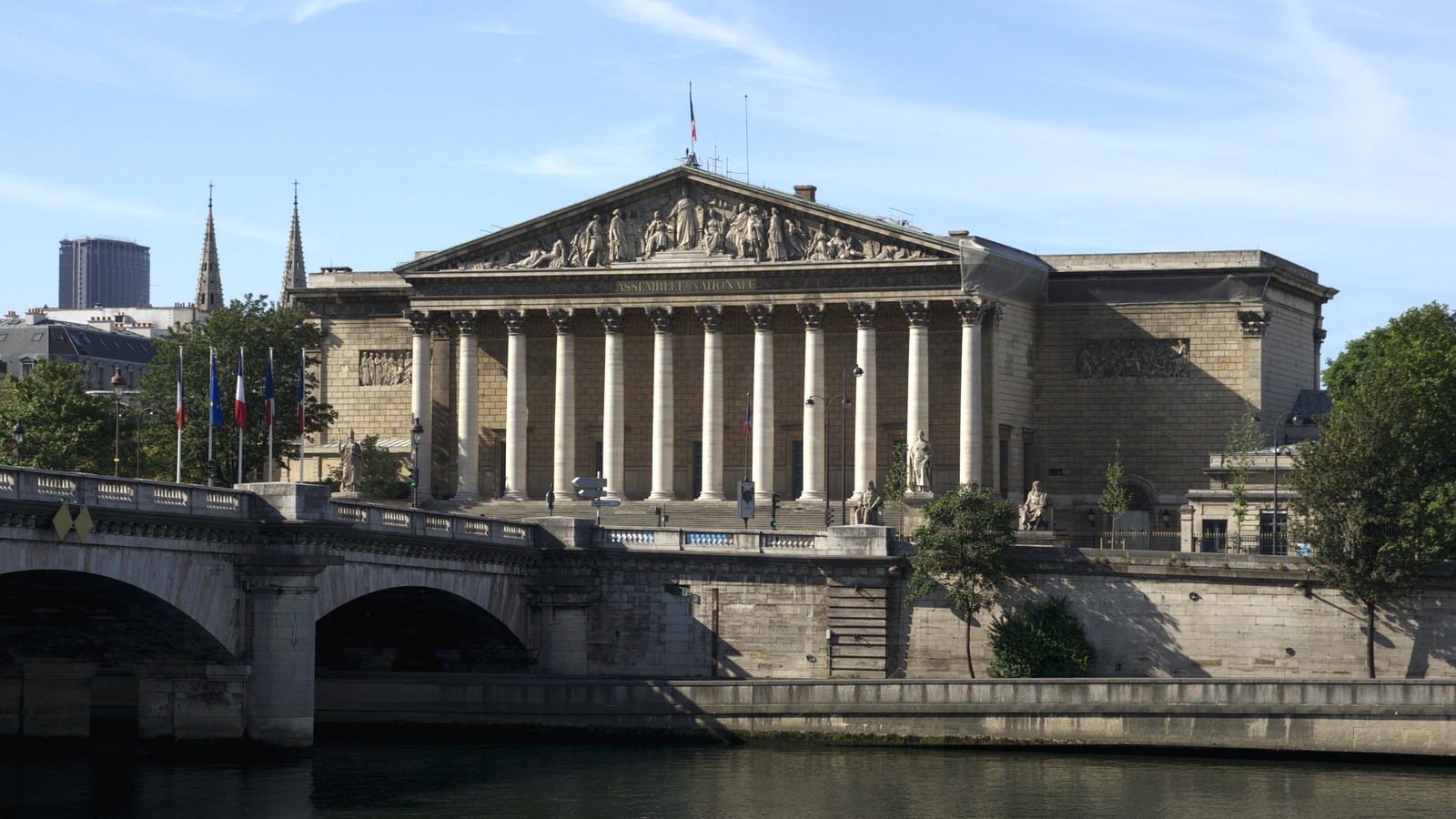
The Palais Bourbon, home of the French National Assembly. High taxes and high spending are ultimately political and institutional choices. · Wikimedia Commons · CC0
6. The hidden foundation is productive capacity
None of this is free. Hospitals need doctors, schools need teachers, pensions require cash, and unemployment insurance requires current contributions. A welfare state can redistribute resources only after an economy has produced them.
France therefore depends on a productive base that includes aerospace, energy, pharmaceuticals, luxury goods, transport equipment, agri-food, tourism, finance and professional services. The Airbus final assembly line in Toulouse is a useful symbol: a high-welfare economy ultimately needs high-value sectors capable of generating wages, profits and a broad tax base.
Three conditions matter especially: high output per hour, a large population of taxpayers and contributors, and a state capable of collecting revenue and delivering services. A high-welfare state cannot be financed only by ‘taxing the rich’. The middle class pays a great deal — and also receives a great deal.

The Airbus A330 final assembly line in Toulouse — a reminder that generous welfare ultimately rests on productive, high-value sectors. · Wikimedia Commons · CC BY-SA 2.0
7. The system changes the bargaining power of ordinary life
The most interesting achievement of the French model may not be the size of benefits but the social psychology created by them. If catastrophic risks are not borne entirely by the individual, people can defend time outside work more confidently.
Paid holidays, retirement and limits on working time therefore become part of an institutional idea of the good life: work is important, but work does not automatically own every remaining hour. French culture matters, but institutions reinforce that culture by giving non-work time legal and economic value.
8. The problem is that the machine is becoming more expensive
The fiscal numbers now expose the model’s constraints. France recorded a general-government deficit of 5.1% of GDP in 2025. Public debt stood at about 115.7% of GDP at the end of 2025, and INSEE reported 117.5% of GDP in the first quarter of 2026.
Growth is modest. The OECD estimates real GDP growth of around 0.9% in 2025 and projects about 0.7% in 2026. That combination creates a difficult triangle: benefits are politically hard to reduce, taxes are already high, and the economy is not growing fast enough to make the arithmetic easy.
Raising taxes risks weakening investment incentives. Cutting benefits triggers political resistance. Extending working lives affects deeply held expectations about retirement. Borrowing more pushes debt-service costs into the future.
9. Pension reform reveals the entire contradiction
Pensions are where demographics, fiscal mathematics and social rights collide. A pay-as-you-go pension system works most comfortably when there are many contributors for each retiree. Ageing reverses that ratio: more people draw benefits for longer while the working-age population grows slowly.
The 2023 reform sought gradually to raise the legal retirement age from 62 to 64. Yet France’s 2026 social-security financing law suspended part of the timetable for 2026 and 2027. That reversal illustrates how difficult it is to adjust a benefit once citizens have treated it as an earned right.
For a finance ministry, an additional year of work is a variable in a model. For a worker, it is a year of mornings, commutes, deadlines and physical effort. Welfare reform is therefore never only economics.

A Paris demonstration against pension reform in March 2023. Retirement policy turns fiscal arithmetic into a conflict over time and rights. · Wikimedia Commons · CC BY-SA 4.0
10. There is no fifth option
The long-run danger is an asymmetry: welfare promises are politically easy to add and difficult to remove, while productivity cannot be legislated into existence. If public commitments grow faster than the economy that finances them, the gap accumulates.
That leaves only a small set of choices: work more, receive less, pay more tax, or borrow more. Technology and productivity growth can make the trade-off easier, but they do not abolish it.
This is why the most important question for the future of the French model is not whether French workers take too much holiday. It is whether France can raise productivity, increase employment and restore fiscal room without destroying the security that citizens value.
Conclusion: what the French are really buying
The French model is often described as generous welfare. A better word is certainty. Households give up a large share of current income so that illness, unemployment, old age and family circumstances do not have to be financed entirely alone.
It is an expensive social arrangement, and it is becoming more expensive. Yet it explains why many French people defend time, retirement and social protection with such intensity: these are not viewed as gifts handed down by government, but as components of a long-running social contract.
The final constraint remains the oldest one in economics: wealth must be created before it can be redistributed. France’s experiment is therefore not a story of escaping economics. It is a story of choosing a particular way to divide risk, income and time — and of discovering how costly that choice becomes when growth slows.
Sources and Image Credits
Data sources
-
INSEE — In 2025, the public deficit stands at 5.1% of GDP; compulsory levies 43.6%; public expenditure 57.2%. Link
-
INSEE — At the end of Q1 2026, Maastricht debt stood at 117.5% of GDP. Link
-
Eurostat — Social protection benefits expenditure in France was 31.9% of GDP in 2024. Link
-
OECD — Economic Surveys: France 2026; growth, productivity, public-finance analysis and basic statistics. Link
-
OECD — Basic statistics of France, 2025: average hours worked per year 1,498. Link
-
Service-Public.fr — Working-time rules and the 35-hour legal benchmark. Link
-
Vie-publique / Service-Public.fr — 2026 suspension of part of the 2023 pension-reform timetable. Link
Image credits
-
图片授权 / Image credits
-
Cover: Paris 360° panorama from the Eiffel Tower — Armin Hornung, Wikimedia Commons, CC BY-SA 3.0. Wikimedia Commons
-
Paris café terrace — zoetnet, Wikimedia Commons, CC BY 2.0. Wikimedia Commons
-
French physicians — Guiguiouch, Wikimedia Commons, CC BY-SA 4.0. Wikimedia Commons
-
French National Assembly, Palais Bourbon — Jebulon, Wikimedia Commons, CC0 1.0. Wikimedia Commons
-
Airbus A330 final assembly line, Toulouse — José Goulão, Wikimedia Commons, CC BY-SA 2.0. Wikimedia Commons
-
Paris pension-reform demonstration, 23 March 2023 — Roland Godefroy (Teddyyy), Wikimedia Commons, CC BY-SA 4.0. Wikimedia Commons



An Economic History of France
How France evolved from an agrarian kingdom into a modern economy through royal finance, revolution, industrialization, state planning, welfare, and high-value industry.

A Brief History of France: From Monarchy and Revolution to the Republic
How France built a centralized state and spent two centuries negotiating liberty and authority, equality and elite rule, revolution and republican government.
From Land Taxes to Corvée Labor: How Qin Funded an Empire
Qin had no modern income taxes or bond market. Its fiscal power came from turning land, households, grain, labor, and military manpower into resources the state could identify and mobilize.