The Real AI Winners Won't Be Selling AI
AI pragmatism: don't sell the technology, sell the better product. The biggest AI winners may be application companies that use AI quietly to create better products and workflows.
The next generation of AI winners may not look like AI companies at all. They may look like better healthcare services, better finance tools, better entertainment products, better productivity workflows, and better local software businesses.
1. The mistake: treating AI as the product
For the past few years, “AI-powered” has been one of the easiest ways to make a product sound modern. It signals ambition. It creates curiosity. It may even help with fundraising or first-click attention. But attention is not the same as willingness to pay.
Customers do not wake up wanting to buy “AI features.” They want a report finished faster, a decision made with more confidence, a claim processed with fewer errors, a trip planned with less friction, or a piece of content adapted to their audience without starting from zero. In other words, people pay for outcomes, not labels.
That is the deeper point behind Chi-Hua Chien’s argument in TechCrunch. The model companies matter, and the frontier of AI research will continue to be important. But for most builders, the larger opportunity is not to sell AI itself. It is to use AI quietly inside products that solve real jobs better than before.
2. The internet analogy: infrastructure starts the era, applications capture the habit
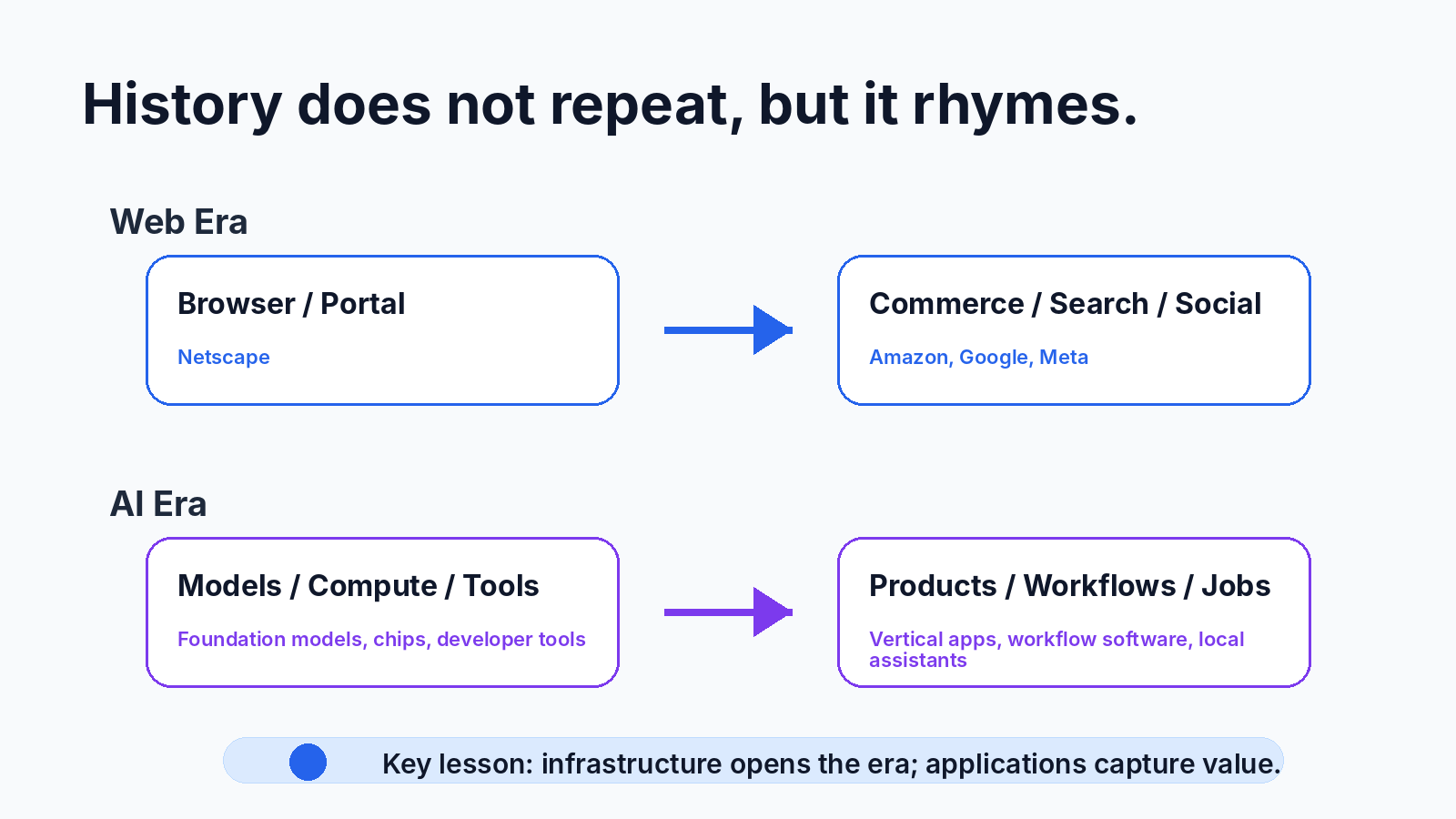
Netscape was one of the defining symbols of the early web. It made the internet visible and usable for millions of people. In that sense, it helped create the age. But the companies that ultimately captured daily behavior were not simply “internet access” companies. They were application companies: Amazon for buying, Google for finding, Meta for social connection, Netflix for entertainment, and later Uber and Airbnb for real-world coordination.
The lesson is not that infrastructure is unimportant. The lesson is that infrastructure becomes most valuable when it disappears into a new normal. Browsers, bandwidth, payments, databases, and cloud servers made modern products possible. But users built habits around products that answered specific needs.
AI may follow a similar path. Models, GPUs, inference platforms, and developer tools open the door. But the enduring consumer and business value is likely to be captured by products that turn AI into a better workflow, a more personalized experience, or a cheaper way to deliver scarce expertise.
3. Model quality will improve; that does not automatically create product quality
One reason this matters is that the model layer is already moving toward price competition and commoditization. Large technology companies have advantages in distribution, computing scale, data centers, operating systems, browsers, and bundled subscriptions. When a capability becomes widely available, “we use a strong model” stops being a durable strategy.
Product quality lives outside the model. It depends on when the AI appears, what context it has, how the user corrects it, where the output goes, how mistakes are handled, whether the workflow saves time, and whether privacy and cost are under control. These are product questions, not model questions.
The strongest AI products often feel less like chatbots and more like completed work. The user does not need to think about prompting. The system simply classifies the invoice, drafts the summary, checks the anomaly, fills the form, routes the ticket, or recommends the next step.
4. AI pragmatism: a product philosophy for builders
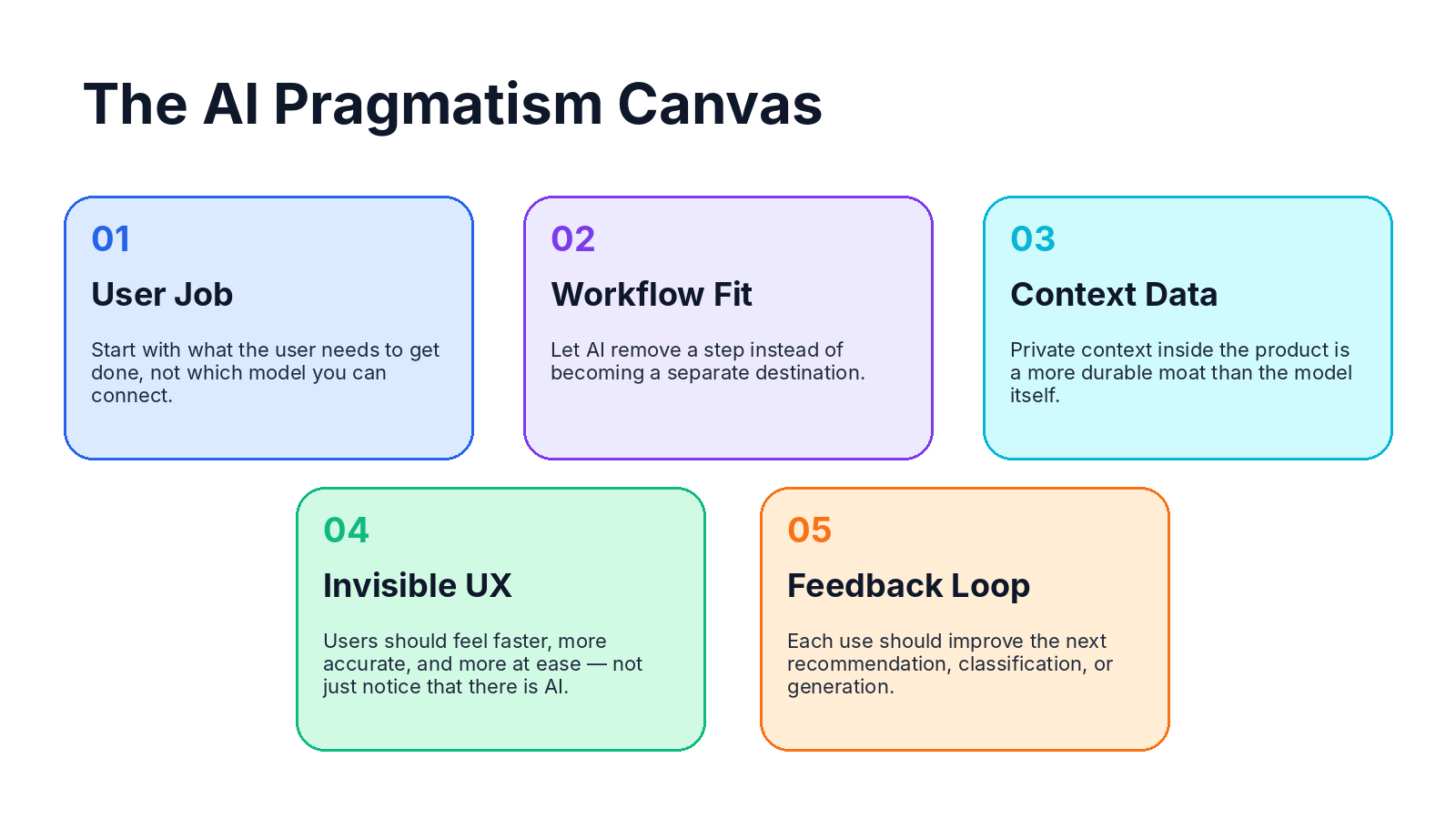
AI pragmatism means using AI as a production layer rather than a marketing layer. It starts with five questions:
- What job is the user trying to finish? Define the task first, not the model capability.
- Where does that job already happen? Embed AI into existing workflows rather than creating a new complex entry point.
- What private context can make the output better than a generic chatbot? Use real context to make the product smarter about the user’s specific scenario.
- Which step can be removed, shortened, or made safer? Let the user see results, not technical performance.
- How does every use create feedback that improves the next use? Build a feedback loop that makes every classification, recommendation, and generation more accurate over time.
This is especially important for indie builders and small businesses. They do not need to compete with frontier model companies. They can compete on specificity. A small tool for receipt collection, a local government document checker, a study assistant for exam preparation, or a dashboard for a family server can all become more useful when AI is embedded in the right place.
The best design choice may be to avoid the word AI in the primary action. “Auto-sort,” “summarize,” “check anomalies,” “generate checklist,” and “prepare draft” are often clearer than “AI assistant.” Users understand actions faster than technologies.
5. A practical checklist
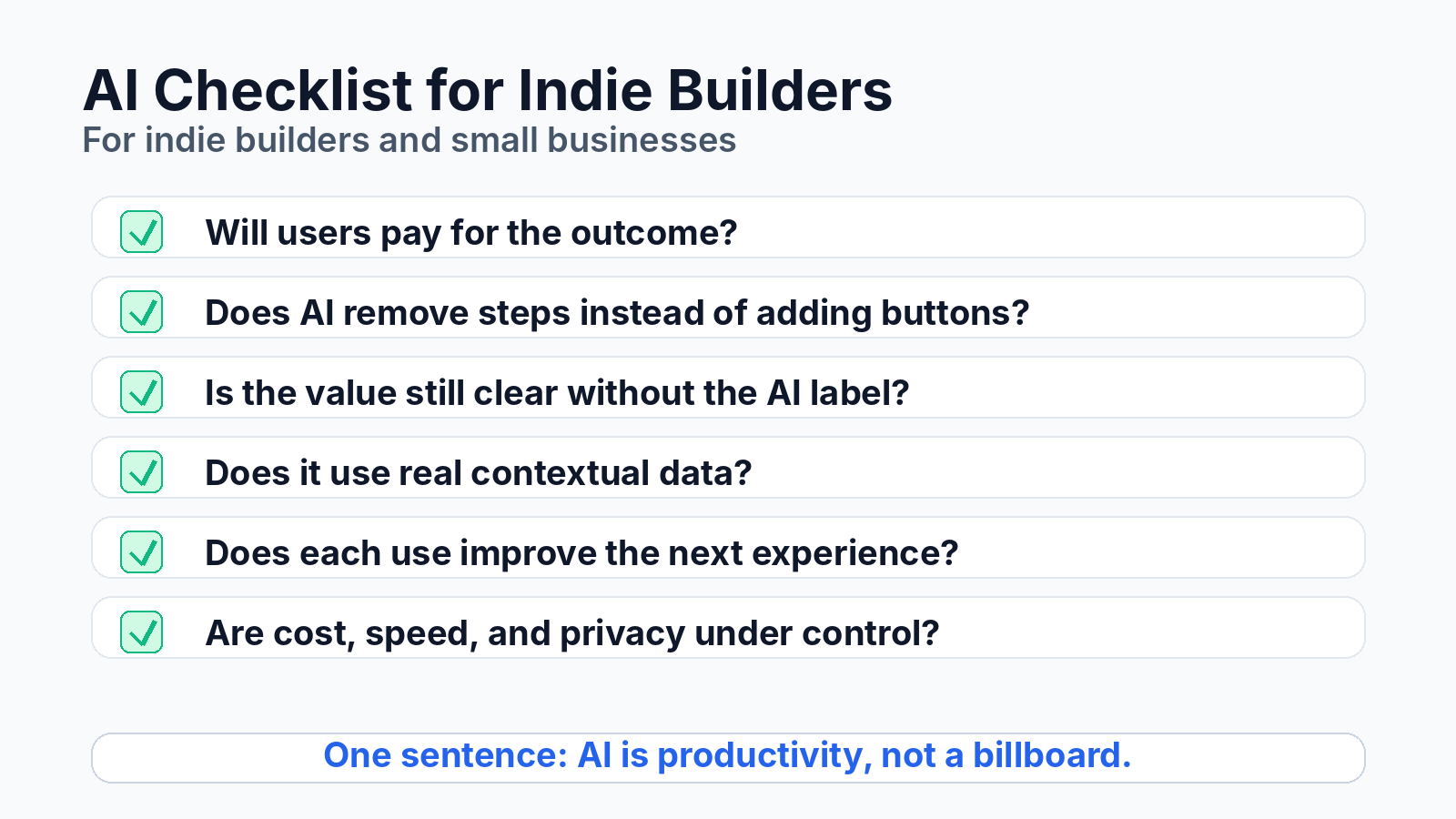
Before adding AI to a product, ask whether the value would still be understandable without the AI label. If the answer is no, the product may be selling novelty rather than utility.
Ask whether the AI removes steps or adds steps. A feature that requires the user to open a separate assistant, explain the task, copy the result, and paste it back may be impressive but not useful. A feature that appears inside the existing workflow and eliminates repeated effort is much stronger.
Ask whether the product has context. Generic AI is powerful, but generic AI is also easy to copy. Durable value often comes from templates, historical data, user preferences, approval rules, domain vocabulary, and the small workflow details that only appear after real usage.
Finally, ask whether the economics work. AI has costs: tokens, latency, quality assurance, privacy, and failure handling. A pragmatic product uses AI where it creates visible value, not everywhere it is technically possible.
6. The quiet future of AI products
In a few years, fewer companies may describe themselves as AI companies. Not because AI becomes less important, but because it becomes more normal. The internet disappeared into every product. Cloud computing disappeared into every startup. Mobile disappeared into every customer journey. AI may do the same.
That future favors builders who understand users more deeply than they understand hype cycles. The winners will not necessarily be the companies with the loudest AI branding. They may be the companies that make work lighter, decisions clearer, services cheaper, and experiences more personal.
The real question for builders is therefore simple: What can you make meaningfully better now that AI exists? Start there. Hide the complexity. Deliver the outcome.
References:
[1] TechCrunch — Connie Loizos, “Chi-Hua Chien saw Facebook coming — now he says the real AI winners won’t be selling AI,” June 17, 2026. [2] TechCrunch Podcast — Maggie Nye, “The return of the consumer gold rush? What Chi-Hua Chien is betting on next,” June 16, 2026. [3] WIRED — Tony Long, “Aug. 9, 1995: When the Future Looked Bright for Netscape,” Aug. 9, 2007. [4] Reuters Breakingviews — “Netscape IPO casts a shadow from 1995 over AI boom,” July 24, 2025.

I Can Only Say: I'm Jealous — Cursor's Founder Speedrun
The story of Cursor's founders, the rise of Anysphere, the SpaceX deal, and the painful FTX stake that could have become $3 billion.

ChatGPT Adoption Shows AI Is Becoming a Daily Global Utility
OpenAI data reveals that users send 50% more messages after 6 months, non-English speakers now make up the majority of active users, and the number of distinct use cases per user has doubled — signaling ChatGPT is moving from a novel chatbot to a daily global utility.

AI Agents Are Moving From Chat to Delegated Work
OpenAI research shows 80.6% of Codex users have delegated tasks exceeding 30 minutes of human work. The age of AI-as-chatbot is giving way to AI-as-delegated-worker, and the implications extend far beyond software engineering.