ChatGPT Adoption Shows AI Is Becoming a Daily Global Utility
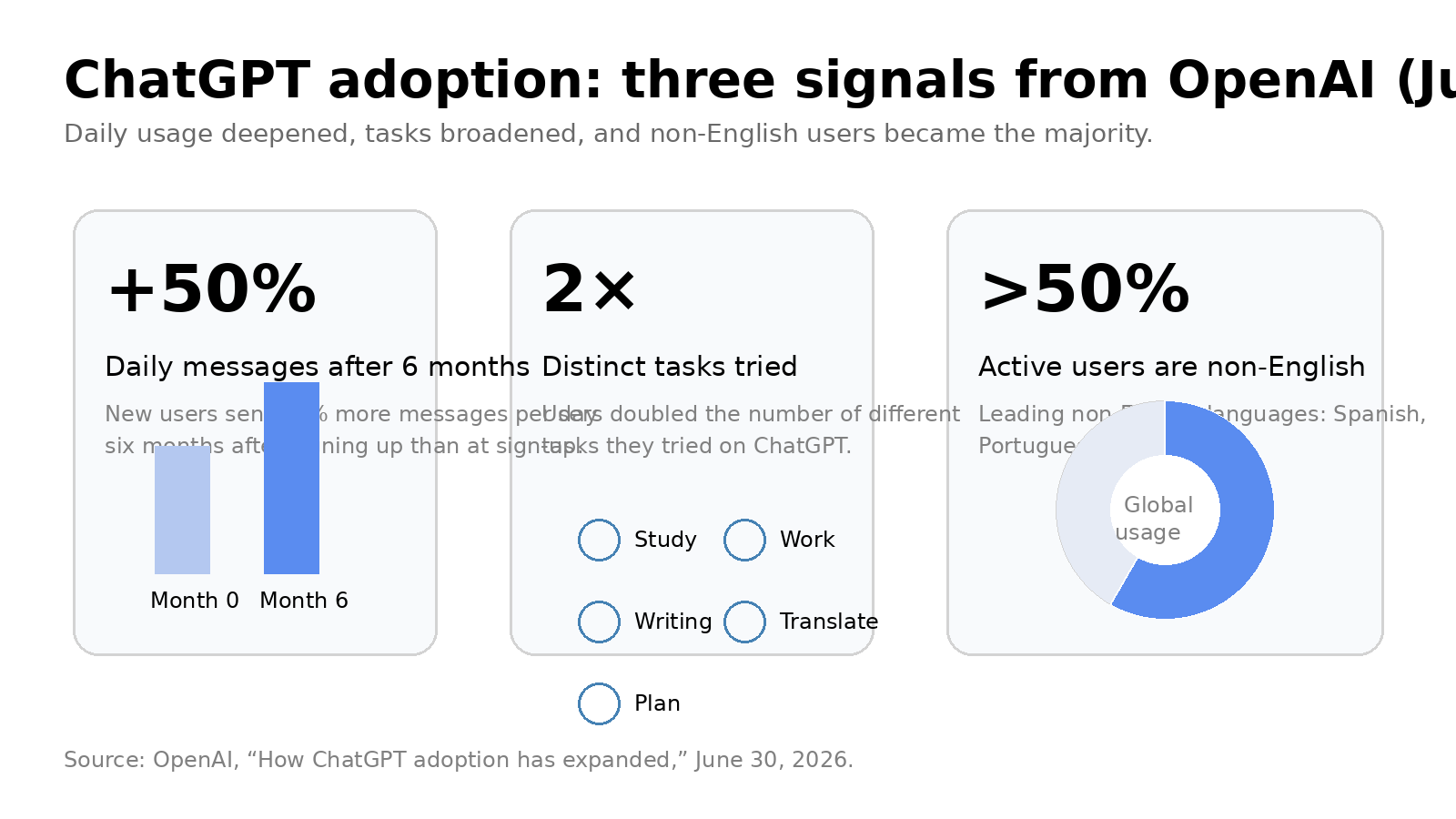
OpenAI data reveals that users send 50% more messages after 6 months, non-English speakers now make up the majority of active users, and the number of distinct use cases per user has doubled — signaling ChatGPT is moving from a novel chatbot to a daily global utility.
A lot of AI discussion still revolves around a very simple metric: how many users does a product have? But the more important question is not how many people sign up once. It is whether people keep returning, use the product more often, and gradually embed it into work, learning, and everyday life. OpenAI’s June 30, 2026 update, “How ChatGPT adoption has expanded,” offers exactly that kind of signal. It shows that ChatGPT is not only getting larger. It is getting deeper, broader, and more global.

1. Depth of use: people use it more, not less, over time
The first notable signal is depth of use. OpenAI says that six months after signing up, users send 50% more messages per day than they did when they first registered. At the same time, they double the number of distinct tasks they have tried on ChatGPT.
That is a meaningful pattern. Users are not just opening ChatGPT once in a while to ask a question. They are gradually widening the range of things they do with it: explaining concepts, rewriting emails, translating text, planning trips, drafting content, summarizing reports, and more. In other words, usage is becoming habitual rather than occasional.
This flips the usual growth narrative for consumer products, where novelty fades over time. ChatGPT appears to be one of those rare tools that becomes more useful the longer you use it, as you discover new applications for it.
2. Global diversification: non-English users are now the majority
The second signal is global diversification. According to OpenAI, people who predominantly use a language other than English now account for more than half of all active users. The leading non-English languages are Spanish, Portuguese, and Arabic.
This matters because it suggests that ChatGPT is no longer mainly an English-first utility with an international audience on the side. It is becoming a genuinely global product, used in many regions and in many linguistic contexts. That kind of shift expands both the user base and the kinds of problems the product can solve.
For users outside the English-speaking world, this is a meaningful development. It means the product’s quality in their language is good enough to sustain habitual use. It also means the feedback loop from non-English users increasingly shapes how the model improves.
3. Frequency and breadth are growing together
The third signal is that higher frequency and broader use are happening simultaneously. OpenAI emphasizes that over time, users both “do more things” and “do things more” on ChatGPT.
This is important because it highlights the real growth logic of AI products. Early growth can come from curiosity and novelty. Long-term growth comes from repeated use across multiple scenarios. A product that people try once may gain attention, but a product that people use more intensely six months later has started to become part of their workflow.
The combination of deepening usage and expanding use cases creates a compounding effect. The more scenarios you use ChatGPT for, the more natural it becomes to reach for it in new situations. And the more you use it, the better you get at framing tasks that produce useful results.
4. Why these signals reframe the AI competition
These data points help reframe the competition in AI. Many conversations still focus on model benchmarks, parameter sizes, or headline capabilities. Those things matter, but from a product perspective the key question is different: does the product become useful often enough to matter in daily life?
The adoption signals OpenAI shares suggest that ChatGPT is moving from a single-purpose conversational tool to a more general-purpose digital utility. That shift is larger than a feature update. It points to a change in how people organize knowledge work and everyday tasks.
This is also why user acquisition alone is not enough. Every technology product wants more users, but the quality of growth depends on retention, habit formation, and scenario expansion. If users come back after six months, send more messages, and use more capabilities, the product is not just growing in traffic. It is growing in utility. That is a much stronger foundation for long-term relevance.
5. What this means for ordinary users
First, AI literacy is becoming a practical, composite skill. The people who benefit most may not be those who know the most about model architectures, but those who know how to plug AI into concrete tasks. Students can use it to explain concepts and support language learning. Office workers can use it for summarization, drafting, and information organization. Creators can use it for brainstorming, outlining, translation, and visual planning. The core value is not in asking a single clever prompt; it is in making AI a repeatable part of real work.
Second, language barriers are shrinking. Once non-English users make up the majority of active users, the meaning is clear: AI is becoming useful to a wider portion of the world on their own terms. That makes AI more likely to function as broad productivity infrastructure rather than a specialized tool for a narrow technical audience.
Third, the key question for the future is not whether people have tried AI, but whether they can keep using it productively. A first encounter can create excitement, but sustained value comes from repeated integration into routines. OpenAI’s data suggest that once people discover how AI fits their needs, they do not merely continue to use it; they deepen and expand that use over time.
Conclusion
The strongest takeaway from OpenAI’s latest adoption data is simple: the long-term value of an AI product is not only about how many new users it acquires, but whether users rely on it more often and across more scenarios over time. That is why these numbers matter. They do not merely show that AI remains popular. They show that ChatGPT is increasingly functioning as a daily global utility — across languages, across devices, and across use cases.
Seen this way, ChatGPT’s expansion is more than product growth. It reflects a broader transition in which general-purpose AI is moving from an early-adopter tool in mostly English-speaking contexts toward a more universal layer of digital infrastructure. For individuals, the most useful question is no longer whether AI will matter. It is how to make it part of one’s own daily toolkit.
Written by Cirbinus. The views expressed are the author’s own and do not represent OpenAI or any other organization.
References
- OpenAI, How ChatGPT adoption has expanded, June 30, 2026.
- OpenAI Signals, methodology notes in the same article.

AI Agents Are Moving From Chat to Delegated Work
OpenAI research shows 80.6% of Codex users have delegated tasks exceeding 30 minutes of human work. The age of AI-as-chatbot is giving way to AI-as-delegated-worker, and the implications extend far beyond software engineering.
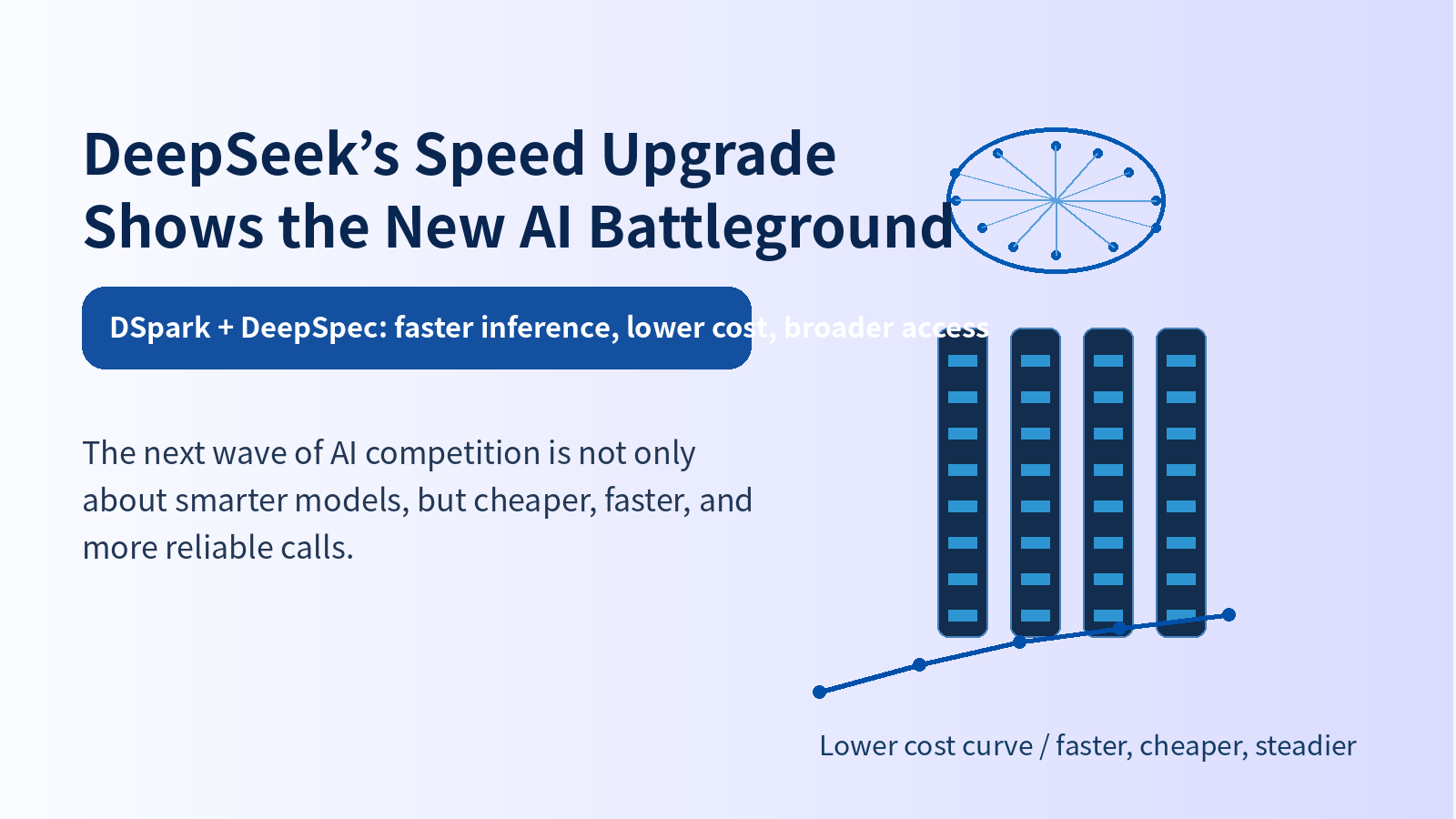
DeepSeek's Speed Upgrade Shows the New AI Battleground
DeepSeek V4 introduces DSpark speculative decoding, boosting inference speed by 60-85%. The next AI battleground is not smarter models but cheaper, faster, more reliable engineering.

Codex Is Becoming a Remote Workspace, Not Just a Coding Tool
OpenAI Codex Remote reaches GA — Codex is shifting from a code generation assistant to a supervised remote workspace that connects mobile, hosts, SSH, and cloud environments into one workflow.