DeepSeek's Speed Upgrade Shows the New AI Battleground
DeepSeek V4 introduces DSpark speculative decoding, boosting inference speed by 60-85%. The next AI battleground is not smarter models but cheaper, faster, more reliable engineering.
For much of the past year, AI competition has been framed around model intelligence: larger models, better benchmarks, stronger reasoning. But DeepSeek’s latest V4 update points to another increasingly important frontier: engineering efficiency.
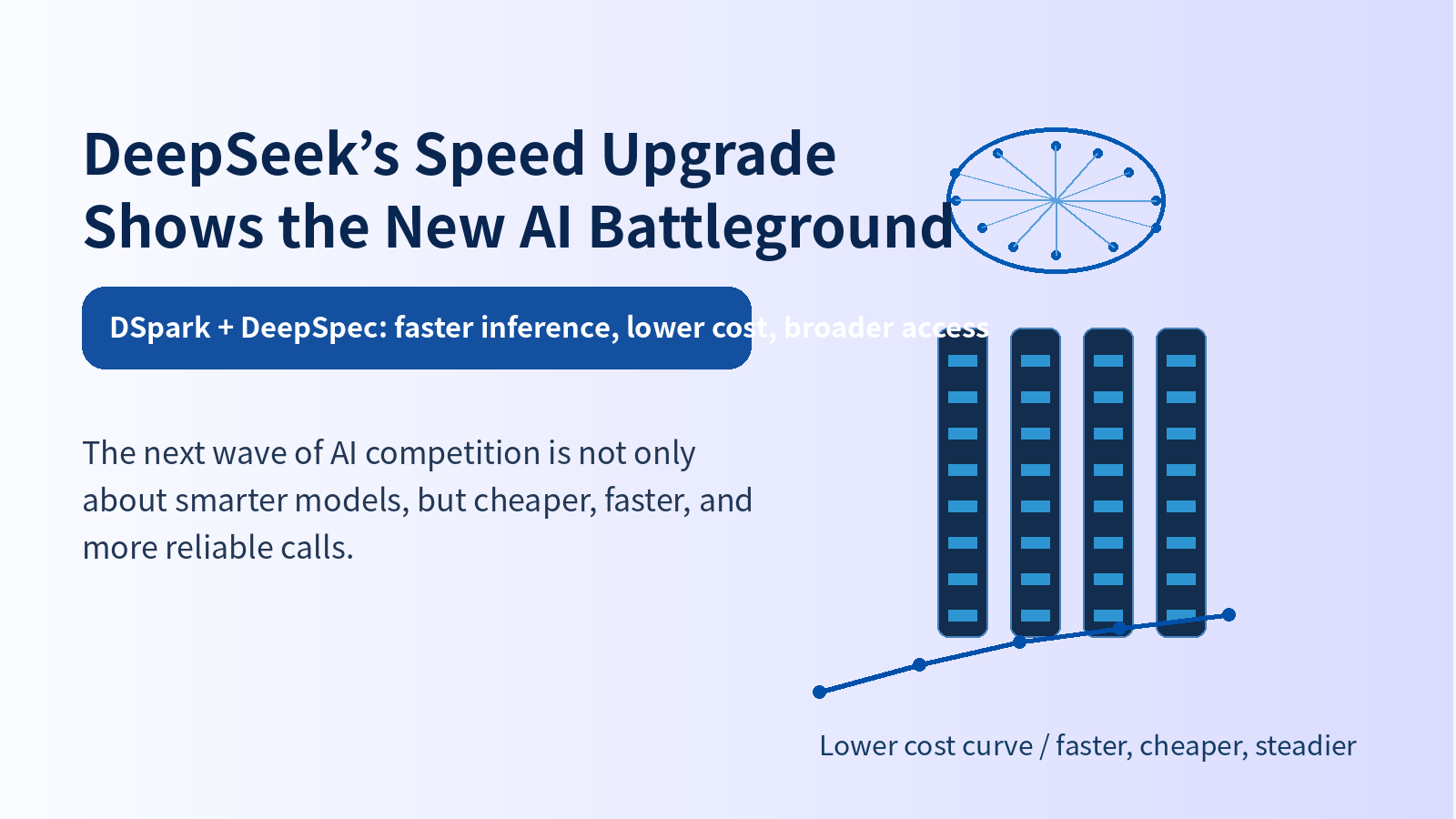
On June 27, reports showed that DeepSeek introduced DSpark, a speculative decoding framework for DeepSeek V4, while open-sourcing DeepSpec, a full-stack codebase for training and evaluating draft models for speculative decoding. This was not presented as a new model architecture. Instead, it was an optimization layer designed to make existing DeepSeek-V4 models faster, cheaper to serve, and easier to deploy at scale.
That distinction matters. As frontier models become more capable, the next stage of AI adoption will depend not only on whether models are smarter, but on whether each call is cheaper, faster, and more reliable. In real products, inference speed and serving cost are not side details. They are the difference between a demo and a durable workflow.
From model capability to engineering efficiency
DeepSeek’s official V4 Preview release on April 24 already emphasized cost-effective 1M context length. According to DeepSeek’s API documentation, V4-Pro has 1.6T total parameters and 49B active parameters, while V4-Flash has 284B total parameters and 13B active parameters. The product direction was clear: long context, strong capability, and practical serving efficiency.
The DSpark update extends that logic. Chinese media outlet 36Kr reported that DeepSeek-V4-Pro-DSpark is not a brand-new architecture, but a speculative decoding module added on top of DeepSeek-V4-Pro. In other words, the core story is engineering implementation rather than a model-capability reset. That is precisely why it is worth paying attention to.
What DSpark is trying to solve
Large language models traditionally generate text token by token. That sequential process creates latency, especially in high-concurrency and long-output scenarios. Speculative decoding addresses this by using a lighter draft model to propose multiple candidate tokens, then asking the target model to verify them in batches. The goal is to convert part of the sequential waiting process into a more parallel verification process.
DSpark’s reported contribution is to make this more production-ready. Media reports describe two ideas: semi-autoregressive generation, which preserves parallel drafting while modeling dependencies within token blocks; and confidence-scheduled verification, which uses confidence signals and hardware-aware scheduling to avoid wasting compute on low-value draft tokens. Put simply, DSpark aims to guess smarter and verify more economically.
This is why the reported speed gains matter. The acceleration range was summarized as 60% to 85% on DeepSeek-V4 Flash and 57% to 78% on DeepSeek-V4 Pro, with throughput improvements ranging from 51% to 400%. These figures should be read as scenario-dependent: actual results will vary by hardware, concurrency, prompt shape, and deployment framework. But the direction is important: inference efficiency is becoming a central part of AI competitiveness.
Why DeepSpec matters for the open-source ecosystem
Alongside DSpark, DeepSeek open-sourced DeepSpec. The GitHub repository describes DeepSpec as a full-stack codebase for training and evaluating draft models for speculative decoding. It includes data preparation utilities, draft model implementations, training code, and evaluation scripts, and is released under an MIT license.
This turns the speed-up story from a single product feature into a broader engineering toolkit. Open-source AI ecosystems do not grow only through model weights. They grow through inference frameworks, evaluation scripts, deployment examples, and reusable tools that help developers reproduce and adapt improvements. DeepSpec may therefore matter not only for DeepSeek’s own models, but for the wider open-source model community.
The HuggingFace model card for DeepSeek-V4-Pro-DSpark further shows how adoption can be supported through familiar tooling: Transformers, vLLM, and SGLang examples are listed. For developers, this kind of compatibility is often as important as the headline benchmark. A model becomes useful when it can be integrated into existing workflows without excessive friction.
Why this lowers the adoption barrier
First, faster inference improves user experience. Many AI tools fail not because they are useless, but because they are slow, unstable, or expensive to run at scale. Speed makes AI feel more interactive and dependable.
Second, lower serving cost makes more use cases economically viable. Document processing, knowledge-base Q&A, customer support, lightweight analytics, and internal automation all benefit when each call becomes cheaper and more predictable.
Third, open tooling reduces ecosystem friction. If DeepSpec-style workflows can be adapted to other open models such as Qwen or Gemma, the practical frontier of open-source AI will expand from model releases to inference optimization, evaluation, and deployment engineering.
What different users should watch
Developers should watch inference frameworks, caching, batching, and concurrency, not just API quality. For small products, unit cost often determines whether an AI feature can survive beyond a prototype.
Enterprises should compare models not only by benchmark scores, but by latency, throughput, stability, ecosystem compatibility, and total cost of ownership. For high-frequency internal workflows, engineering efficiency can matter as much as raw capability.
Individual users and creators should expect AI tools to feel more responsive and more embedded in daily workflows. As serving becomes cheaper and faster, AI can move from occasional experimentation to routine work infrastructure.
Conclusion: the new AI battleground
DeepSeek’s DSpark update looks like an inference-speed improvement on the surface. More broadly, it signals a shift in AI competition. Model intelligence still matters, but when capabilities converge, engineering efficiency becomes decisive.
The next AI battleground will not be only inside chat boxes. It will be inside servers, schedulers, inference frameworks, open-source toolchains, and every millisecond of response latency. The most useful AI systems will not simply be the ones that sound the smartest, but the ones that complete real tasks quickly, affordably, and reliably.
Written by Cirbinus. The views expressed are the author’s own.
References
- DeepSeek API Docs. “DeepSeek V4 Preview Release.” 2026-04-24.
- 36Kr / Machine Heart. “DeepSeek V4 Updates DSpark, Inference Speed Up 80%.” 2026-06-27.
- GitHub: deepseek-ai/DeepSpec. Repository README and MIT License.
- HuggingFace: deepseek-ai/DeepSeek-V4-Pro-DSpark model card.
- CryptoBriefing / KuCoin. “DeepSeek Launches DSpark to Boost Inference Speed by 60% to 85%.” 2026-06-27.

ChatGPT Adoption Shows AI Is Becoming a Daily Global Utility
OpenAI data reveals that users send 50% more messages after 6 months, non-English speakers now make up the majority of active users, and the number of distinct use cases per user has doubled — signaling ChatGPT is moving from a novel chatbot to a daily global utility.

AI Agents Are Moving From Chat to Delegated Work
OpenAI research shows 80.6% of Codex users have delegated tasks exceeding 30 minutes of human work. The age of AI-as-chatbot is giving way to AI-as-delegated-worker, and the implications extend far beyond software engineering.
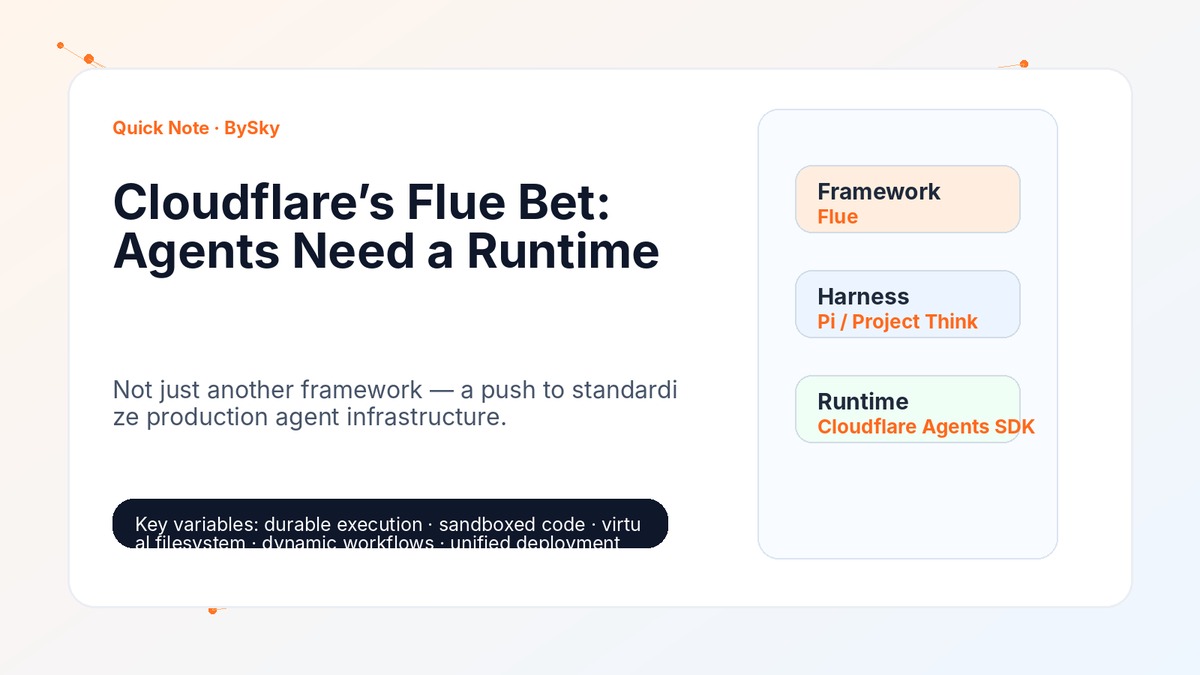
Cloudflare's Flue Bet: Agents Need a Runtime, Not Just a Framework
Cloudflare is trying to standardise the runtime layer for production agents — durable execution, sandboxed code, lightweight workspaces, and platform bindings.