Cloudflare's Flue Bet: Agents Need a Runtime, Not Just a Framework
Cloudflare is trying to standardise the runtime layer for production agents — durable execution, sandboxed code, lightweight workspaces, and platform bindings.
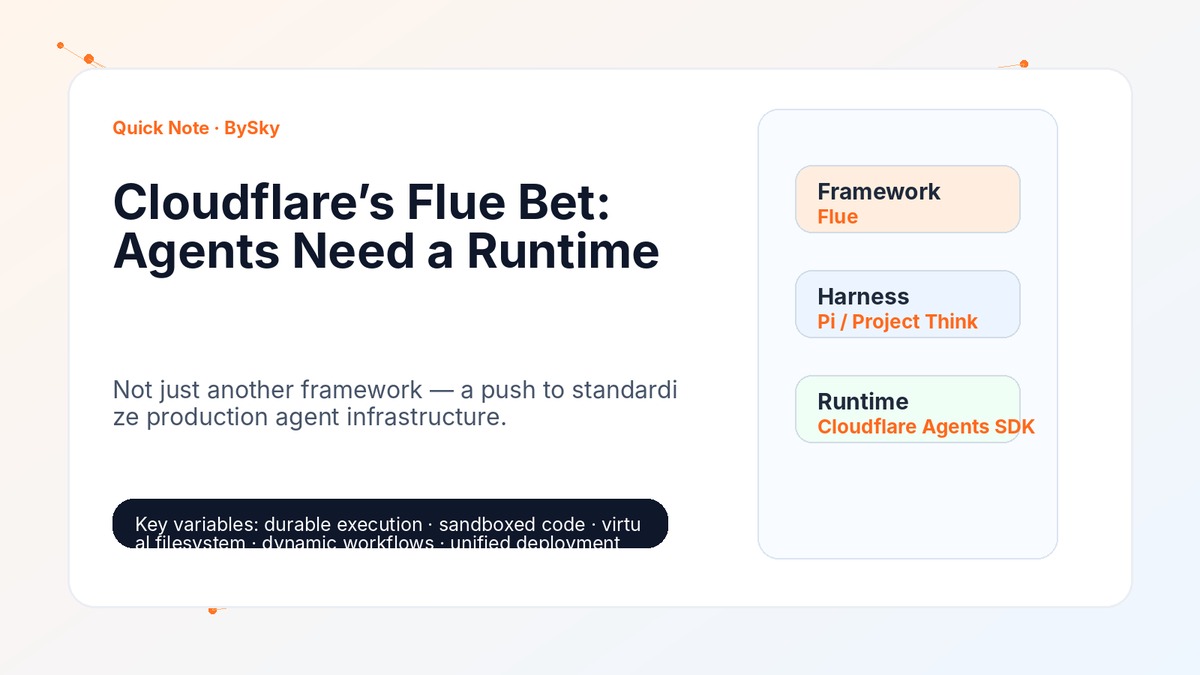
Quick note: The interesting part is not that another agent framework exists. The interesting part is Cloudflare trying to turn agents into durable, recoverable, edge-native infrastructure.
The interesting part
Cloudflare’s new post about Flue looks, at first glance, like another framework announcement in an already crowded agent market. But I think the more important story is deeper in the stack: Cloudflare is trying to standardise the runtime layer for production agents.
Most agent conversations still start at the framework layer. We compare LangChain, CrewAI, AutoGPT, OpenAI Agents SDK, and a growing list of orchestration tools. That makes sense for prototypes. But once an agent becomes production infrastructure, the hard questions move downward: how does it survive restarts, resume a long task, execute generated code safely, store files, wait for approvals, control credentials, and remain observable?
What Flue is
Flue is an open-source TypeScript framework from the team behind Astro. Its 1.0 Beta is built on the Pi harness and is the first framework Cloudflare highlights as targeting the Cloudflare Agents SDK. In practice, Flue is the developer experience layer: project structure, CLI, integrations, frontend hooks, and a declarative way to describe what an agent knows and can do.
Cloudflare frames the production agent stack as three layers. The top layer is the framework, such as Flue. The middle layer is the harness, such as Pi or Project Think, which runs the agentic loop: reading context, calling tools, managing state, and continuing the task. The bottom layer is the runtime/platform, where Cloudflare wants the Agents SDK to sit: compute, state, storage, durable execution, workflows, and bindings.
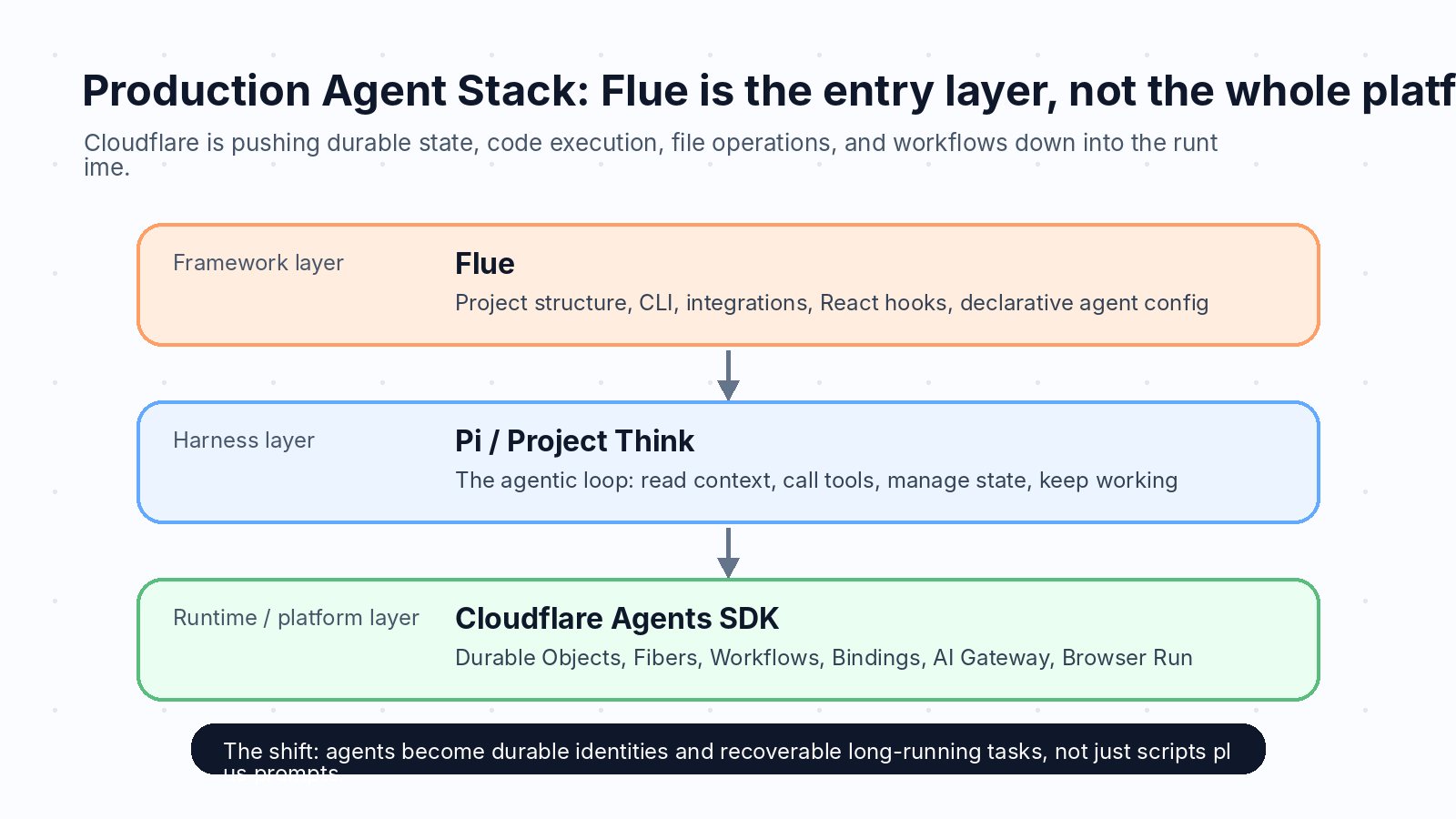
This separation is important. It means the agent ecosystem might shift from “which framework is most popular” to “which runtime platform can host the most frameworks and harnesses.” Cloudflare’s goal is not just to build Flue — it is to make room for more harnesses to run on Cloudflare’s underlying capabilities.
Why the runtime matters
A useful agent is rarely a single request-response transaction. It may read a GitHub issue, reproduce a bug, create a branch, edit code, run tests, wait for CI, ask for approval, and then open a pull request. It may sit inside Slack or Linear and wake up only when an event arrives. It may spend 99% of its life waiting.
That is why production agents need a different substrate. Cloudflare’s model treats agents as durable identities, not always-on processes. State, SQL data, schedules, and fibre checkpoints can survive hibernation and restarts. The agent can sleep when idle, wake on events, and resume work from saved checkpoints instead of losing the whole turn.
Every problem from traditional web applications gets amplified here: what happens when a process dies, a model call times out, a tool execution fails mid-way? Where is file state stored? Where does generated code run safely? Does an agent that spends 99% of its time waiting need a permanently running server?
Cloudflare’s answer is to treat agents as “identities with state that can sleep and be woken by events.” This is what Durable Objects, Fibres, Workflows, and Bindings provide. They are not built for demos. They are built for production failures, long-running tasks, waiting, and recovery.
The core capabilities
Durable execution. An agent can checkpoint its progress through Fibres during a task. When the process is recycled or restarted, it resumes from the latest checkpoint instead of leaving the user staring at a spinning loader.
Sandboxed code execution. Rather than overwhelming the model with a large collection of tools, Cloudflare prefers a pattern where the model writes a small TypeScript or JavaScript function that calls the APIs it needs. The platform runs that generated code in an isolated Dynamic Worker with only the bindings the developer provides.
Lightweight durable workspace. Many agent tasks are file-oriented but do not need a full Linux container. Reading files, grepping code, writing patches, and generating diffs can happen in a virtual filesystem backed by Durable Objects and SQLite. Containers remain available when the agent needs a full OS.
Dynamic workflows. When an agent needs a repeatable multi-step pipeline, the workflow itself can be generated at runtime and handed to the platform. The platform persists steps, retries failures, sleeps for hours, and waits for external events or human approval.
Platform bindings. Agents can access capabilities such as AI Gateway, Browser Run, Email, Agent Memory, AI Search, and Containers without directly exposing raw credentials to model-generated code. Cloudflare’s binding system gives the agent capability without handing over secrets.
How it compares
I would not frame Flue as a direct replacement for LangGraph, CrewAI, AutoGPT, or OpenAI Agents SDK. They sit at different parts of the stack and optimise for different buyers.
LangGraph is a low-level orchestration framework and runtime for long-running, stateful agents, especially strong when you want explicit graph control, durable execution, streaming, and human-in-the-loop workflows.
CrewAI emphasises agents, crews, flows, guardrails, memory, knowledge, observability, and enterprise automation. Its learning curve is relatively intuitive.
AutoGPT has moved closer to a user-facing automation platform: describe a task, build visually, run in the background, and monitor from a dashboard.
OpenAI Agents SDK is attractive when your server owns orchestration, tool execution, state, approvals, and needs Python or TypeScript control, tools, MCP, handoffs, guardrails, and observability.
Flue plus Cloudflare is different because the centre of gravity is the runtime. It says: bring your harness, bring your framework, but run it on a platform that already has Durable Objects, event-driven compute, workflow persistence, sandboxed execution, and global deployment.
What to watch
If you are building a simple Q&A bot, Flue is probably not your first priority. A regular API plus database plus model call will suffice.
But if you are building background agents — automated GitHub issue triage, daily research aggregation, Slack or Discord event processing, long-running research tasks, automated report generation, or human-approval workflows — the Cloudflare path is worth watching. It pushes the painful parts — deployment, state recovery, event wake-up, sandboxing, credential isolation, cost control — as far as possible into the platform layer.
The caveats are obvious. Flue is still early. API stability needs time to settle. The deeper you lean into Cloudflare’s primitives, the more you inherit its platform assumptions. And not every workload belongs on an edge-first runtime: heavy builds, complex OS dependencies, and GPU-heavy jobs may still need containers or specialised infrastructure.
Still, the direction feels right. The competition used to be about who orchestrates more elegantly. Flue suggests the next phase will be lower: who can keep an agent alive, let it safely call tools and code, make it observable, billable, recoverable, and scalable.
Flue itself may or may not become the most popular agent framework. But the layer Cloudflare is targeting — the production runtime for agents — is the layer that will matter next.

ChatGPT Adoption Shows AI Is Becoming a Daily Global Utility
OpenAI data reveals that users send 50% more messages after 6 months, non-English speakers now make up the majority of active users, and the number of distinct use cases per user has doubled — signaling ChatGPT is moving from a novel chatbot to a daily global utility.

AI Agents Are Moving From Chat to Delegated Work
OpenAI research shows 80.6% of Codex users have delegated tasks exceeding 30 minutes of human work. The age of AI-as-chatbot is giving way to AI-as-delegated-worker, and the implications extend far beyond software engineering.
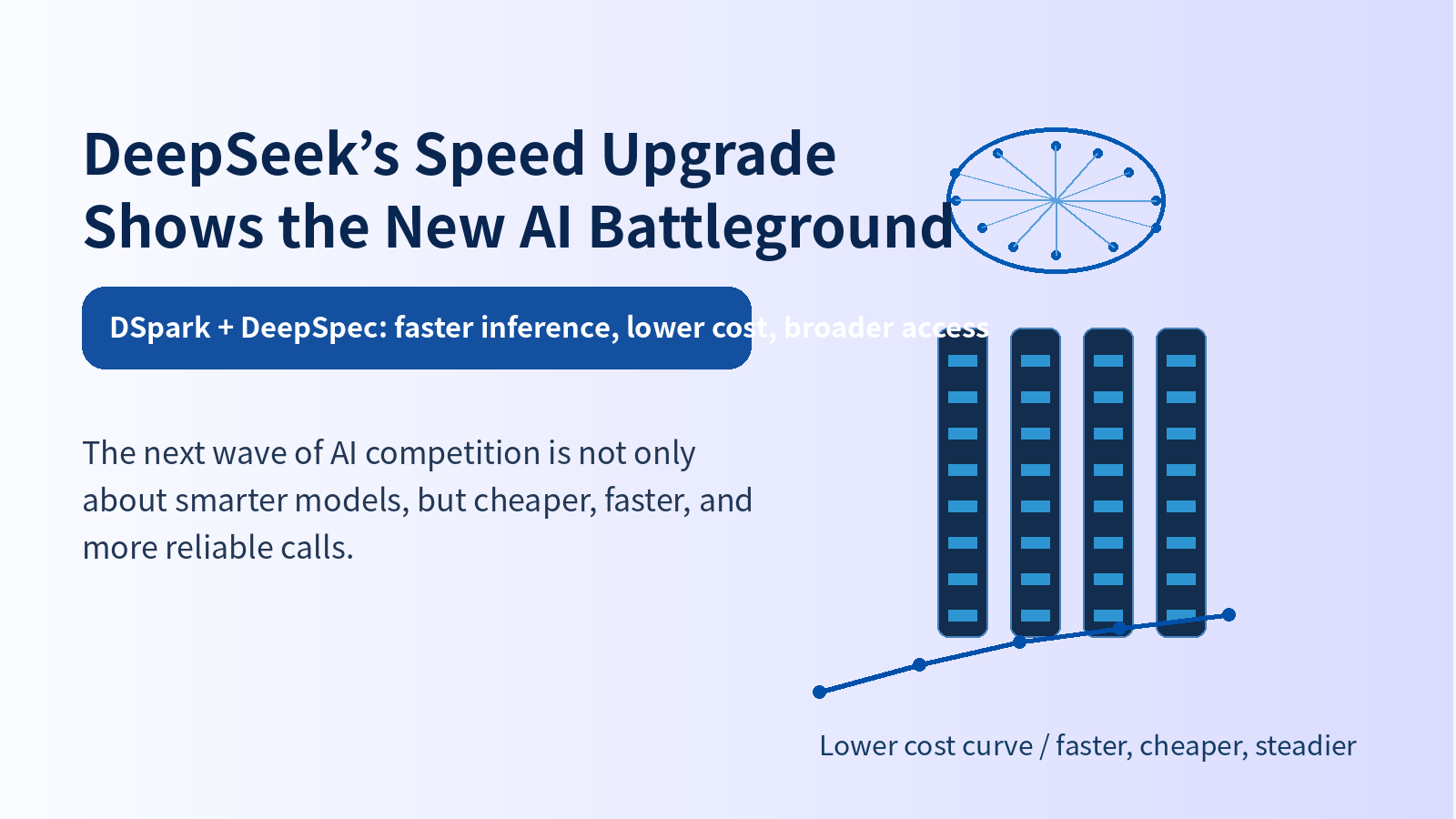
DeepSeek's Speed Upgrade Shows the New AI Battleground
DeepSeek V4 introduces DSpark speculative decoding, boosting inference speed by 60-85%. The next AI battleground is not smarter models but cheaper, faster, more reliable engineering.