I Can Only Say: I'm Jealous — Cursor's Founder Speedrun
The story of Cursor's founders, the rise of Anysphere, the SpaceX deal, and the painful FTX stake that could have become $3 billion.
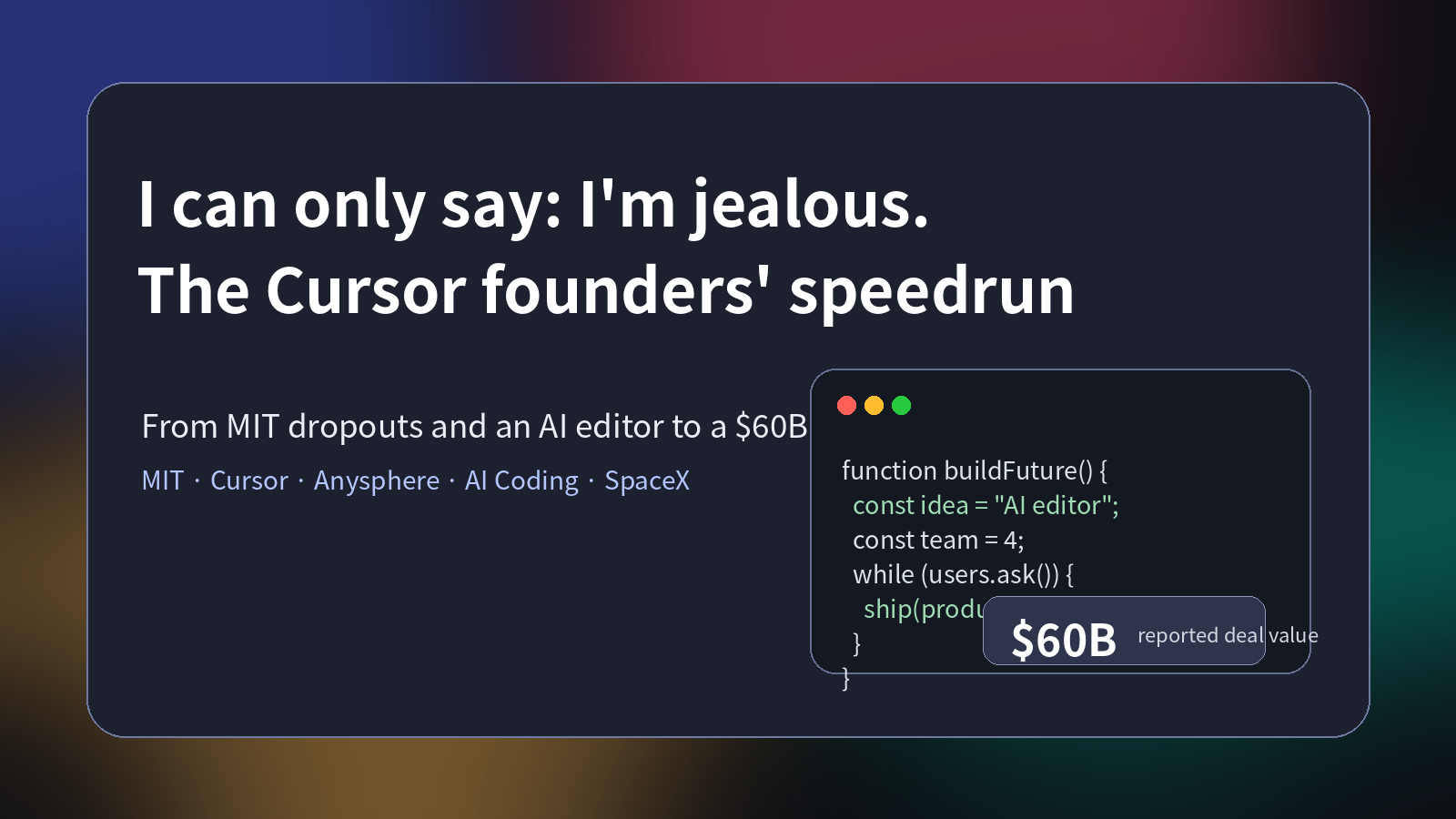
I can only say: I’m jealous. Not in a bitter way, but in the very human way you feel when four people in their mid-twenties turn a code editor into a reported $60 billion story. Cursor is not a rocket company, not a chip company — it is a code editor. And yet it became one of the most valuable private software companies of the AI era.
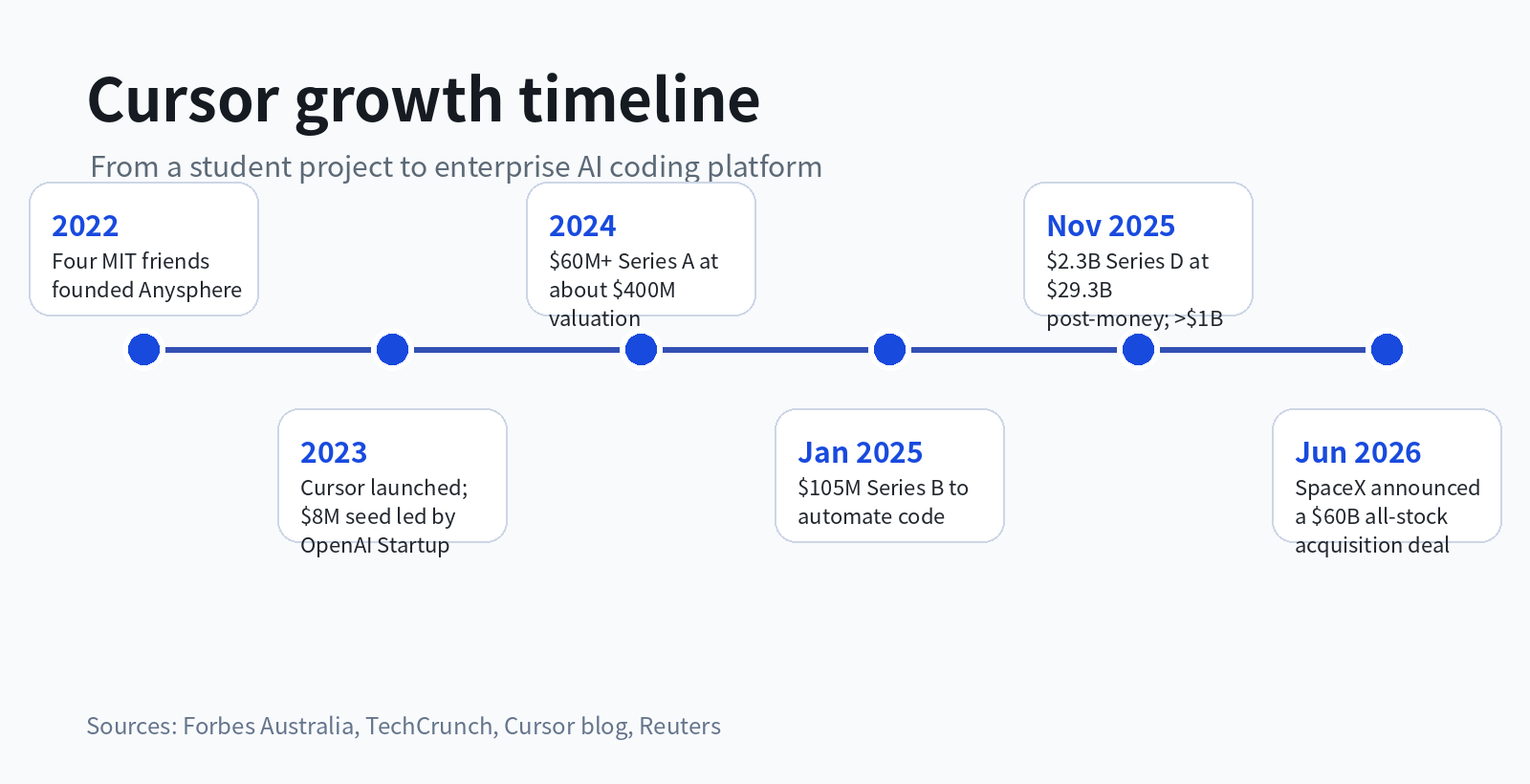
Cursor is built by Anysphere, founded by Michael Truell, Sualeh Asif, Arvid Lunnemark and Aman Sanger, four friends who met at MIT. The company was founded in 2022, launched Cursor in 2023, and by June 2026, Reuters reported SpaceX’s $60 billion all-stock acquisition of Anysphere.
1. Cursor won because it lived inside the workflow
Many AI products start as a chat box bolted onto an existing product. Cursor did something more powerful: it put AI inside the place where developers already spend their day — the editor.
That small product choice matters. Developers do not want to copy code into a web chat, re-explain the repository, paste results back, and then manually repair context loss. Cursor sits in the codebase, understands files, dependencies, project context, and intent. It starts with single-line completion and code explanation, then moves toward multi-file editing, agent execution, and review.
In other words, Cursor is not selling “AI is cool.” It is selling “you can ship faster today.” That is a much stronger product promise. Once developers build a habit around it, they are unlikely to go back.
2. The funding curve was almost unreal
The public timeline is extreme. In 2023, TechCrunch reported that Anysphere raised an $8 million seed round led by OpenAI Startup Fund. In 2024, TechCrunch reported a $60 million-plus Series A at roughly a $400 million valuation from a16z and Thrive.
Then the curve bent upward. In November 2025, Cursor announced a $2.3 billion Series D at a $29.3 billion post-money valuation, while also saying it had more than 300 employees and more than $1 billion in annualized revenue.
By June 2026, Reuters reported SpaceX’s $60 billion all-stock acquisition of Anysphere. In only a few years, a focused developer tool became a strategic asset in the enterprise AI race. Forbes Australia estimated each of the four founders held roughly 4.5% of the company — worth approximately $1.3 billion per person before the SpaceX deal.
3. The FTX footnote is almost too painful
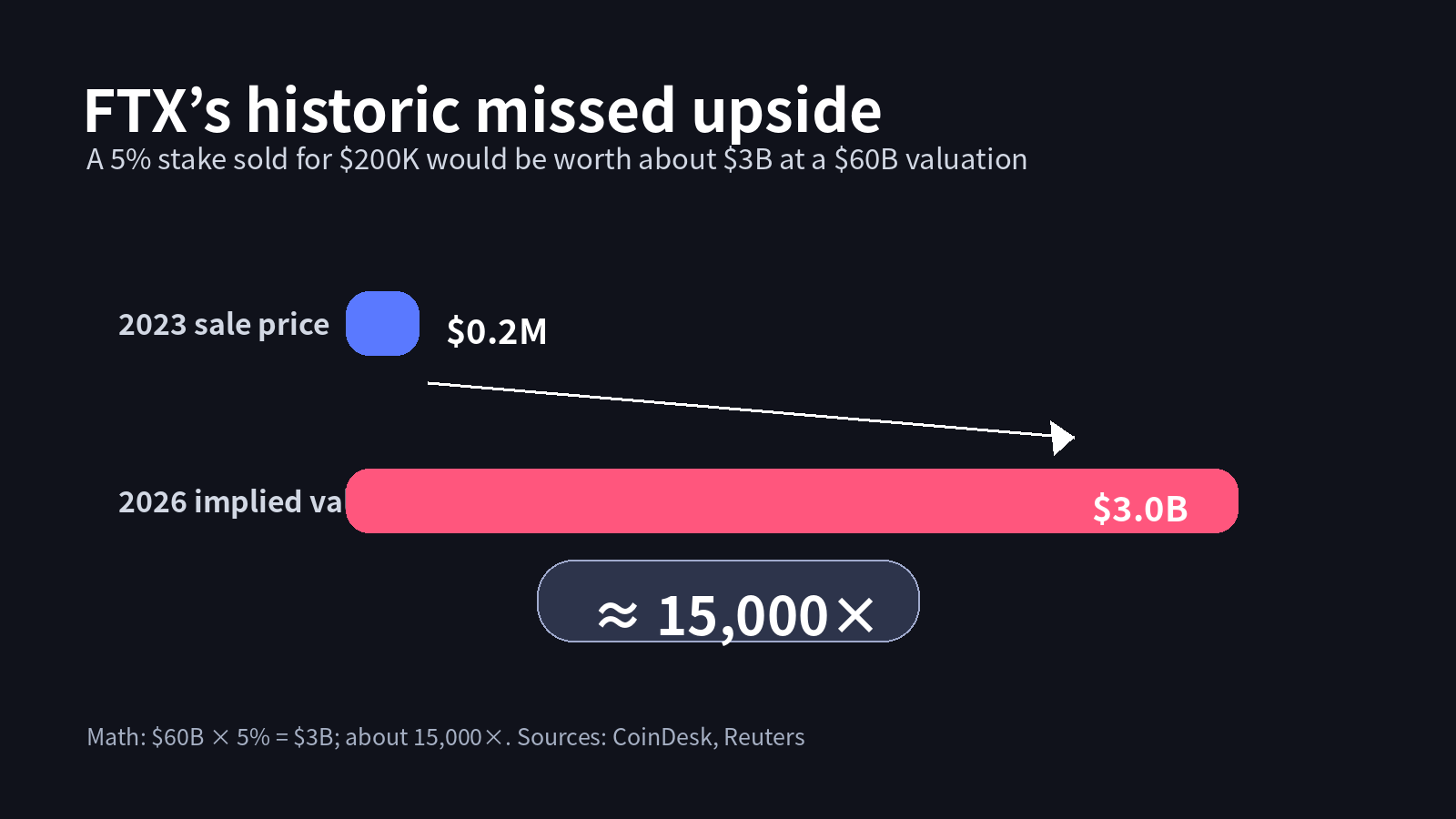
There is also a brutal cap-table subplot. CoinDesk reported that Alameda Research invested $200,000 in Anysphere in 2022 for roughly 5% of the company. After FTX collapsed, the bankruptcy estate sold that position for the same $200,000 in 2023.
At a $60 billion valuation, 5% is worth about $3 billion. That means a $200,000 position, if held, would have become roughly $3 billion — about a 15,000x outcome.
This is one of the cruelest lessons in technology investing: seeing an opportunity is not enough. You also need the structure, patience and luck to hold it through the messy middle.
4. Why Cursor broke out
First, it solved a frequent and expensive problem. Software engineering is not an occasional workflow; it is a daily loop of reading, changing, reviewing and shipping. Even small productivity gains compound heavily in this environment.
Second, it used a familiar entry point. Cursor felt close enough to the editor habits developers already had, which lowered switching costs. For a developer tool, “no retraining required” is a growth advantage, not a minor detail.
Third, it turned model capability into product capability. Users do not care which model sits behind a button if the tool cannot understand their repository or safely edit the right files. Cursor’s advantage is not the model — it is the workflow, the context, the interface, and the closed loop between editing and execution.
Fourth, it stood right at the shift from autocomplete to agents. The category moved from “write this line” to “understand this task and change the codebase.” Cursor was ready for that shift because its product architecture was built for it.
5. What I am really jealous of
I am not jealous of the money. Well, I am a little jealous. But what I find more impressive is the timing: they identified a narrow, high-frequency, painfully real entry point right when the category was shifting. They did not try to build an “AI operating system” or start with a grand theory of everything. They started with one concrete problem: can a developer read, understand, and change code faster?
For independent builders, small teams and founders who are not raising billions, this is the real lesson. The opportunity may not be in building a bigger model. It may be in taking an existing workflow, adding AI quietly and usefully, and making it so much better that users cannot imagine going back.
6. After the jealousy, back to the product
Cursor’s story includes talent, an elite university, lucky timing, and venture capital. But if you only see “MIT dropout, billionaire at 25,” you miss the product lesson. They did not use AI as a sticker. They embedded AI into a daily habit and made it disappear into the workflow.
The wind will shift, and the stories will get old. What stays is the product. The real question for every builder is the same one Cursor answered: what can you make meaningfully faster, cheaper, or better — not by adding AI as a feature, but by redesigning the workflow around it?
References:
[1] Reuters — “SpaceX to buy Anysphere in $60 billion all-stock deal,” June 16, 2026. [2] CoinDesk — “FTX sold its Cursor stake for $200,000 in 2023. It would be worth $3 billion today,” April 23, 2026. [3] Cursor Blog — “Series D: $2.3 billion at $29.3 billion valuation,” November 2025. [4] Forbes Australia — “Four cofounders of popular AI coding tool Cursor are now billionaires.” [5] TechCrunch — “Anysphere raises $8M from OpenAI to build an AI-powered IDE,” October 2023. [6] TechCrunch — “Anysphere raises $60M Series A at $400M valuation from a16z, Thrive,” August 2024.
The Real AI Winners Won't Be Selling AI
AI pragmatism: don't sell the technology, sell the better product. The biggest AI winners may be application companies that use AI quietly to create better products and workflows.
Claude Sonnet 5 Shows the New AI Race Is About Default Workflows
The next moat may be the place a model occupies in daily work, not only its benchmark score.

ChatGPT Adoption Shows AI Is Becoming a Daily Global Utility
OpenAI data reveals that users send 50% more messages after 6 months, non-English speakers now make up the majority of active users, and the number of distinct use cases per user has doubled — signaling ChatGPT is moving from a novel chatbot to a daily global utility.