OpenAI's Custom Chip Shows the Next AI Battleground: Compute
OpenAI and Broadcom unveiled Jalapeño on June 24, 2026 — not just a chip announcement, but a signal that AI competition is shifting to compute infrastructure.
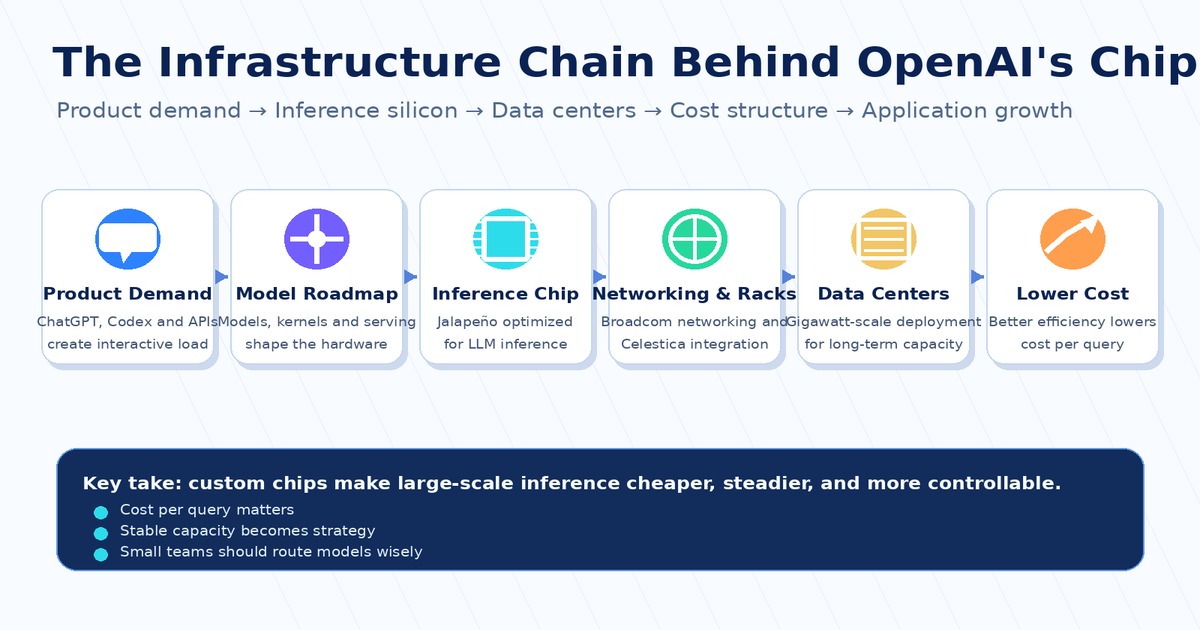
For the past two years, most AI conversations have centered on model capability: context length, multimodality, coding performance, reasoning, and speed. OpenAI and Broadcom’s June 24, 2026 unveiling of Jalapeño shifts attention to a deeper layer: compute infrastructure. OpenAI calls Jalapeño its first Intelligence Processor, a custom accelerator designed around large-language-model inference. It is not a consumer chip. It is infrastructure for ChatGPT, Codex, the API, and future agentic products.
1. This is not just a chip story. It is a full-stack signal.
The key word behind Jalapeño is not simply “chip.” It is “inference.” Training determines what a model can learn; inference determines the cost and experience of every user query, every code generation request, and every API call. OpenAI describes Jalapeño as a blank-slate design for modern LLM inference, informed by its model roadmap, kernels, serving systems, and product needs.
That means OpenAI is no longer only building models and products. It is designing the infrastructure underneath them: chip architecture, memory movement, networking, scheduling, deployment systems, and product experience. The next stage of AI competition will not be decided by models alone. It will also be shaped by compute supply, inference cost, power efficiency, and systems engineering.
2. Why inference chips matter more than they may appear
Most of what users experience as AI is inference. When a person asks ChatGPT a question, when Codex modifies code, or when an API returns a structured answer, the system is doing inference. Training is the big upfront project; inference is the daily operating cost.
Reuters reported that AI labs such as OpenAI and Anthropic are struggling to secure enough computing power for powerful chatbots and coding apps. Developing in-house chips gives companies a way to lower cost and create alternatives to Nvidia GPUs. Jalapeño is designed specifically for inference, the computation that turns a user query into an answer.
3. Broadcom’s role: OpenAI knows the workload; Broadcom industrializes it
OpenAI understands the models and product workloads. Broadcom understands silicon implementation, networking, and large-scale chip platforms. OpenAI says Jalapeño was designed from scratch around its understanding of LLM fundamentals, while Broadcom and Celestica help industrialize the platform through implementation, board and rack integration, high-performance networking, and scalable production systems.
This is the essence of modern AI infrastructure: the chip is only one piece. The real system includes memory, networking, racks, data centers, power, scheduling, and deployment.
4. What 10 gigawatts really means
In October 2025, OpenAI and Broadcom announced a collaboration for 10 gigawatts of OpenAI-designed AI accelerators, with deployment targeted to begin in the second half of 2026 and complete by the end of 2029. The number is striking, but the larger point is strategic: AI companies need to secure years of compute capacity in advance.
As AI products become high-frequency services, compute is no longer just a procurement line item. It becomes a long-term supply-chain, energy, data-center, and partner-ecosystem problem. Whoever can secure more reliable compute and reduce cost per inference has more room to improve products, lower prices, and expand usage.
5. Does this threaten Nvidia?
Not immediately. General-purpose GPUs remain essential for training, research, experimentation, and diverse workloads. Custom ASICs are better suited to stable, high-volume inference tasks where efficiency and cost matter most.
The more likely future is not a simple replacement of GPUs. It is a layered market: GPUs, TPUs, Trainium, custom ASICs, and specialized inference systems will each serve different workload profiles. Nvidia remains central, but hyperscale AI providers will increasingly build custom silicon for the workloads they understand best.
6. What indie developers and small teams should learn from this
This may look like a story only for AI giants, but the lessons apply to smaller builders too. First, AI products are ultimately shaped by cost structure. A good AI app is not only about model quality; it is also about response speed, reliability, and cost per useful action.
Second, small teams should not always use the largest model by default. For tools, mini apps, knowledge bases, invoice workflows, or reading assistants, model routing matters: simple tasks can use cheaper or local models, while difficult tasks can call stronger systems.
Third, caching, batching, prompt compression, and result reuse will become more important. OpenAI is building chips to reduce inference cost at massive scale. Small teams cannot build chips, but they can design systems that avoid unnecessary calls.
Conclusion
OpenAI’s custom chip matters not because it adds another hardware announcement, but because it shows where AI competition is going. The battlefield is moving downward from model releases to chips, networks, data centers, and cost curves.
The future AI company is not only the one with the smartest model. It is the one that can deliver intelligence to more users, more reliably, at a lower cost. Jalapeño is only the beginning. The deeper signal is clear: AI is entering the compute infrastructure era.
Sources: [1] OpenAI, “OpenAI and Broadcom unveil LLM-optimized inference chip”, June 24, 2026. [2] Reuters, “OpenAI unveils custom chip it designed with Broadcom to boost its AI infrastructure”, June 24, 2026. [3] OpenAI, “OpenAI and Broadcom announce strategic collaboration to deploy 10 gigawatts of OpenAI-designed AI accelerators”, October 13, 2025. [4] Broadcom Investor Relations, “OpenAI and Broadcom Unveil LLM-Optimized Intelligence Processor”, June 24, 2026.

ChatGPT Adoption Shows AI Is Becoming a Daily Global Utility
OpenAI data reveals that users send 50% more messages after 6 months, non-English speakers now make up the majority of active users, and the number of distinct use cases per user has doubled — signaling ChatGPT is moving from a novel chatbot to a daily global utility.

AI Agents Are Moving From Chat to Delegated Work
OpenAI research shows 80.6% of Codex users have delegated tasks exceeding 30 minutes of human work. The age of AI-as-chatbot is giving way to AI-as-delegated-worker, and the implications extend far beyond software engineering.
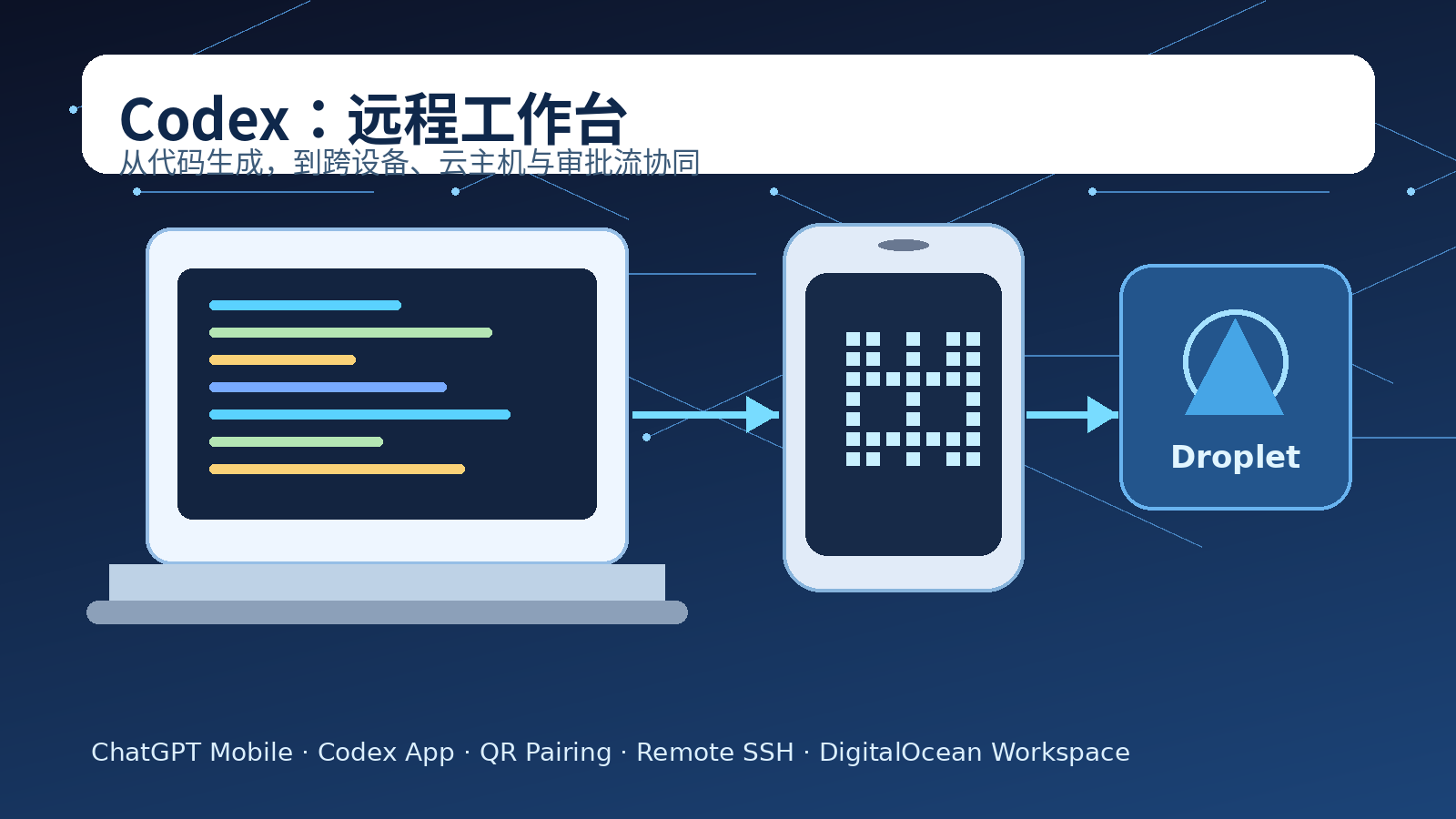
Codex Is Becoming a Remote Workspace, Not Just a Coding Tool
OpenAI Codex Remote reaches GA — Codex is shifting from a code generation assistant to a supervised remote workspace that connects mobile, hosts, SSH, and cloud environments into one workflow.