Nietzsche’s Philosophy
What remains when inherited sources of truth, morality, and meaning lose their authority?
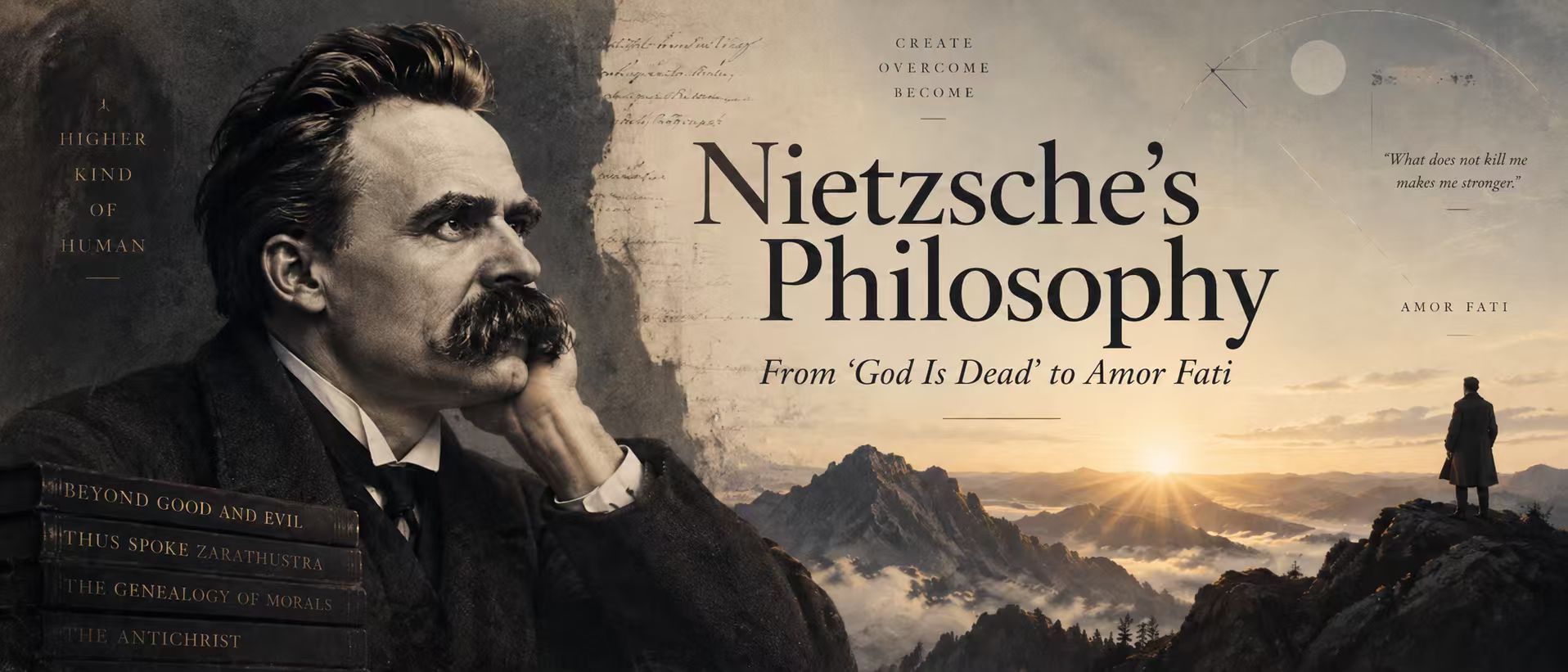
What remains when inherited sources of truth, morality, and meaning lose their authority?
Nietzsche’s philosophy can be introduced through one question: when traditional religion, morality, and ultimate truths no longer seem convincing, what can still give human life strength, creativity, and meaning?
Friedrich Nietzsche (1844–1900) did not build a neat philosophical system in the manner of a textbook. He wrote in aphorisms, polemics, parables, and thought experiments. Again and again, he challenged ideas that had come to seem self-evident and asked where our values came from, what kind of life they served, and what might happen when their authority collapsed.
The following ten ideas provide a practical map of his thought. They are connected by a common problem: how can human beings confront nihilism and create values after older foundations of meaning have weakened?
1. “God Is Dead”
One of Nietzsche’s most famous formulations is “God is dead.” It is not merely a slogan for atheism. It describes a historical and cultural transformation in which Christianity and traditional metaphysics gradually lose their power to function as unquestioned sources of ultimate value.
In an older framework, people could answer major questions by appealing to a transcendent order: why should one be good, what gives life meaning, and what counts as truth? Nietzsche believed that modern science, criticism, and secularization had weakened the authority of those answers.
The deeper problem is therefore what follows. If the old highest values no longer command belief, can human beings avoid falling into nihilism?
2. Nihilism
Nihilism is the condition in which the values once treated as highest lose their binding force. What had appeared to give life a final purpose now seems unable to do so.
This can lead to a disturbing question: if work, success, morality, and life itself have no ultimate guarantee of meaning, why continue striving?
Nietzsche did not simply celebrate nihilism. He treated it as a crisis that modern culture would have to pass through. The task is neither to return uncritically to old certainties nor to remain in the conclusion that nothing matters, but to move through nihilism toward the creation of new values.
3. The Revaluation of Values
Nietzsche argued that many moral values that appear self-evident have histories. Why are humility, obedience, restraint, and sacrifice praised? Why are pride, desire, strength, and self-assertion often treated with suspicion?
His call for a “revaluation of all values” does not simply mean reversing good and evil. It means asking how values arose, what psychological and social conditions produced them, and what forms of life they encourage or suppress.
Again and again, Nietzsche evaluates values in relation to life: whether they strengthen vitality, courage, honesty, creativity, and the capacity to act.
4. Master Morality and Slave Morality
This is one of Nietzsche’s most controversial and easily misunderstood distinctions.
In what he calls master morality, qualities such as strength, courage, pride, and self-affirmation are first experienced as “good.” In slave morality, values emerge through the response of the weaker to the stronger, often through what Nietzsche calls ressentiment. Strength may then be reinterpreted as evil, while humility, patience, and obedience are elevated as virtues.
The point is not a simple endorsement of domination. Nietzsche is analyzing the origin of moral judgment and asking whether a person’s values arise from active creation and self-affirmation, or primarily from fear, envy, and resentment toward others.
5. The Will to Power
Nietzsche is often associated with the “will to power.” If power is understood only as political authority or control over other people, however, the idea becomes too narrow.
The phrase can be understood more broadly as a tendency of life to expand its capacities, overcome resistance, shape itself, and surpass its previous condition. Learning a difficult skill, creating a work of art, breaking a personal limitation, or mastering fear can all help illustrate this dimension of Nietzsche’s thought.
From this perspective, life is not defined simply by the pursuit of comfort. Difficulty and suffering are not automatically signs of failure; in some circumstances they become conditions for growth, creation, and self-overcoming.
6. The Übermensch
In Thus Spoke Zarathustra, Nietzsche introduces the Übermensch, often translated as the “overman” or “superman.” It is not a comic-book hero and not a racial category.
The concept represents a human possibility: a person capable of moving beyond inherited values, creating values for life, and continually overcoming the self.
The central idea is therefore self-overcoming. The question shifts from “What does society expect me to become?” to “What am I willing to become, and can I take responsibility for that form of life?”
7. The Last Man
Opposed to the Übermensch in Thus Spoke Zarathustra is the figure of the “last man.”
The last man seeks safety, comfort, convenience, and the avoidance of risk. Such a life may be stable and pleasant, but it no longer aspires to demanding forms of creation or self-transformation.
Through this figure Nietzsche raises a question about modern life: if comfort and entertainment become the final goals of existence, might a life free from obvious suffering still lose a stronger sense of direction?
8. Eternal Recurrence
Eternal recurrence can be read as one of Nietzsche’s most radical thought experiments.
Imagine being told that the life you are living now will return exactly as it is, endlessly. Every pleasure, failure, regret, and pain will recur without change. How would you respond?
The thought experiment turns the question of affirmation into an extreme test: could someone affirm life so completely that they would be willing to live the same life again and again?
9. Amor Fati
Amor fati—“love of fate”—is closely connected to eternal recurrence.
It is more than resignation. Resignation says that something cannot be changed and must therefore be endured. Amor fati asks whether a person can go further and affirm the life that has actually happened, rather than continually imagining a purified version from which failure, loss, and regret have been removed.
The question is not how to erase the past, but whether one can affirm one’s life together with the experiences that have made it what it is.
10. Apollo and Dionysus
In his early book The Birth of Tragedy, Nietzsche uses Apollo and Dionysus to describe two different forces in human life and art.
The Apollonian represents order, form, measure, boundaries, and clarity. The Dionysian represents passion, instinct, intoxication, disorder, and the temporary dissolution of individual boundaries.
Nietzsche believed that the power of Greek tragedy came from the interaction of these two forces. The contrast also expresses an early theme that remains important throughout his work: human life cannot be reduced to rational order alone; passion, embodiment, instinct, chaos, and suffering are also parts of lived existence.
Nietzsche’s Thought in One Line of Development
The collapse of traditional highest values → “God is dead” → the danger of nihilism → neither a simple return to old certainties nor passive nihilism → revaluation of values → creation of values → self-overcoming → affirmation of life.
Nietzsche therefore does not offer a single ready-made answer to the meaning of life. His work repeatedly returns to a more demanding question: when no external authority can provide a final meaning for you, can you take responsibility for the values by which you live?
“Become who you are” can serve as one thread through Nietzsche’s philosophy. It does not mean doing whatever one happens to want. It points instead toward the harder task of accepting responsibility for one’s choices, overcoming one’s limitations, and shaping a life one can affirm as one’s own.
Nietzsche’s question is not simply, “What is the universal answer to life?” It is also: if no ready-made highest answer remains, how will you live?
Food Safety for Children Aged 2–3: A Practical, Evidence-Based Family Guide
An evidence-based family guide to choking prevention, foodborne illness, allergy emergencies, fish safety and first aid for toddlers aged 2–3.
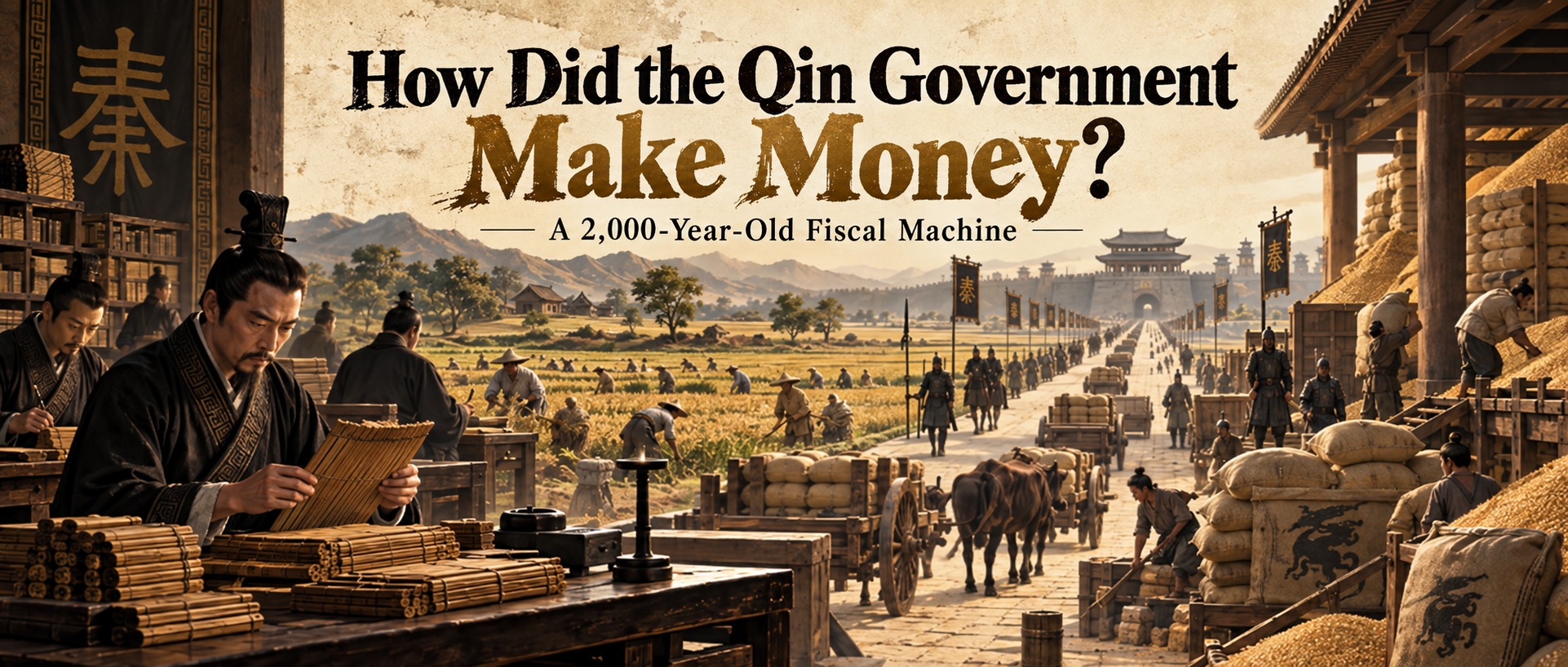
From Land Taxes to Corvée Labor: How Qin Funded an Empire
Qin had no modern income taxes or bond market. Its fiscal power came from turning land, households, grain, labor, and military manpower into resources the state could identify and mobilize.
Why Progress Gets Stuck
Medicine reveals why scientific knowledge does not automatically become affordable, scalable improvements in everyday life.