From Land Taxes to Corvée Labor: How Qin Funded an Empire
Qin had no modern income taxes or bond market. Its fiscal power came from turning land, households, grain, labor, and military manpower into resources the state could identify and mobilize.
From land taxes and household registers to corvée labor: how the Qin state mobilized an empire
2026.09
Imagine the empire of Qin Shi Huang as a gigantic organization. An obvious question follows: how did it pay for itself?
The Qin state had to maintain armies, provision officials, build roads, walls, palaces, and irrigation works, move grain toward distant frontiers, and sustain an administrative hierarchy stretching from the imperial center down to counties and villages. Every one of these tasks consumed enormous resources.
Yet Qin had no modern personal income tax, corporate income tax, or value-added tax. It had no modern banking system and no deep sovereign bond market to finance persistent deficits. So where did the government’s resources come from?
The answer is different from what a modern fiscal mindset might suggest. Qin did not extract only coins. It mobilized a broader bundle of resources: grain, cloth, fodder, land, labor time, military manpower, and some monetary revenue.
To understand Qin finance, then, we should not ask only, “How much cash was in the treasury?” A better question is: when the state needed laborers for a road or grain for an army, could it actually mobilize those resources from society?
1. The Fiscal Foundation: Land
For most premodern agrarian states, the basic fiscal logic was straightforward: control over land and farming households provided the most dependable revenue base. Qin was no exception.
Most people worked in agriculture, while commerce was far smaller than in a modern economy. The broadest and most stable resource base was therefore farmland. Cultivators produced grain, and the state collected land rent and other agricultural obligations, often in kind.
For a long time, historians had only an incomplete picture of how Qin land taxation worked. Excavated texts from Shuihudi, Yuelu, and Liye have made the system much more concrete. Local authorities kept records of land and households, assessed obligations, collected arrears, and moved grain and other goods into government storage.
The Yuelu Qin manuscripts are especially revealing. Provisions associated with the Tian Lü, or “Field Statutes,” show that unpaid rent and fodder obligations could trigger penalties not only for the debtor but also for officials responsible for collection. The key point is not simply that the system could be harsh. It is that fiscal responsibility was attached to identifiable households and identifiable officials.
In modern language, Qin was building a tax base: how much land existed, who was responsible for it, how much was due, and who had to collect it.

Conceptual illustration: local officials recording and receiving grain. This is a historical reconstruction, not an archaeological reproduction.
2. Taxing the Household, Not Just the Field
Land alone was not enough. Harvests fluctuated, and households differed greatly in the amount of land they controlled. Qin also organized fiscal obligations around the registered household.
The Jinbu Lü (“Statutes on Money and Property”) preserved in the Yuelu manuscripts contains unusually specific rules on household levies. Households paid at designated times, sometimes in fodder and sometimes in money; the text even records a payment of sixteen coins in a particular levy.
This tells us that the state did not ask only, “How much grain did your field produce?” It also asked, in effect, “Are you a registered household, and what obligations follow from that status?”
That is why household registration mattered so much. In Qin, registration was not merely identification. It was linked to taxation, corvée, military service, policing, and population movement. Liye documents record household heads, family members, status categories, and other information. Before the state could assess or mobilize people, it first had to know who they were and where they belonged.
The deeper significance of “registering households and equalizing the people” was therefore administrative: scattered families became units that the state could identify, count, assess, and mobilize.
3. A Tax Paid in Time Rather Than Money: Corvée Labor
If we look only at land rent and household levies, we still underestimate Qin’s fiscal capacity. One of the most important burdens was corvée labor.
Corvée was not technically a cash tax, but economically it can be understood as a tax paid in labor time.
Consider a road project. A modern government usually appropriates money, contracts with builders, and pays workers. An ancient state had another option: directly requisition labor. Instead of paying cash to the government, a household might surrender days or months of work.
From the standpoint of resource transfer, both systems redirect part of society’s productive capacity toward public purposes. One transfers money; the other transfers time and labor.
The Yaolü, or “Corvée Statutes,” in the Shuihudi Qin manuscripts regulated the mobilization of labor for public works. This helps explain how Qin could undertake vast infrastructure projects without having to pay every worker a market wage from a cash treasury. The real inputs were grain, human labor, timber, tools, animals, and transport capacity—and many of those could be mobilized directly.
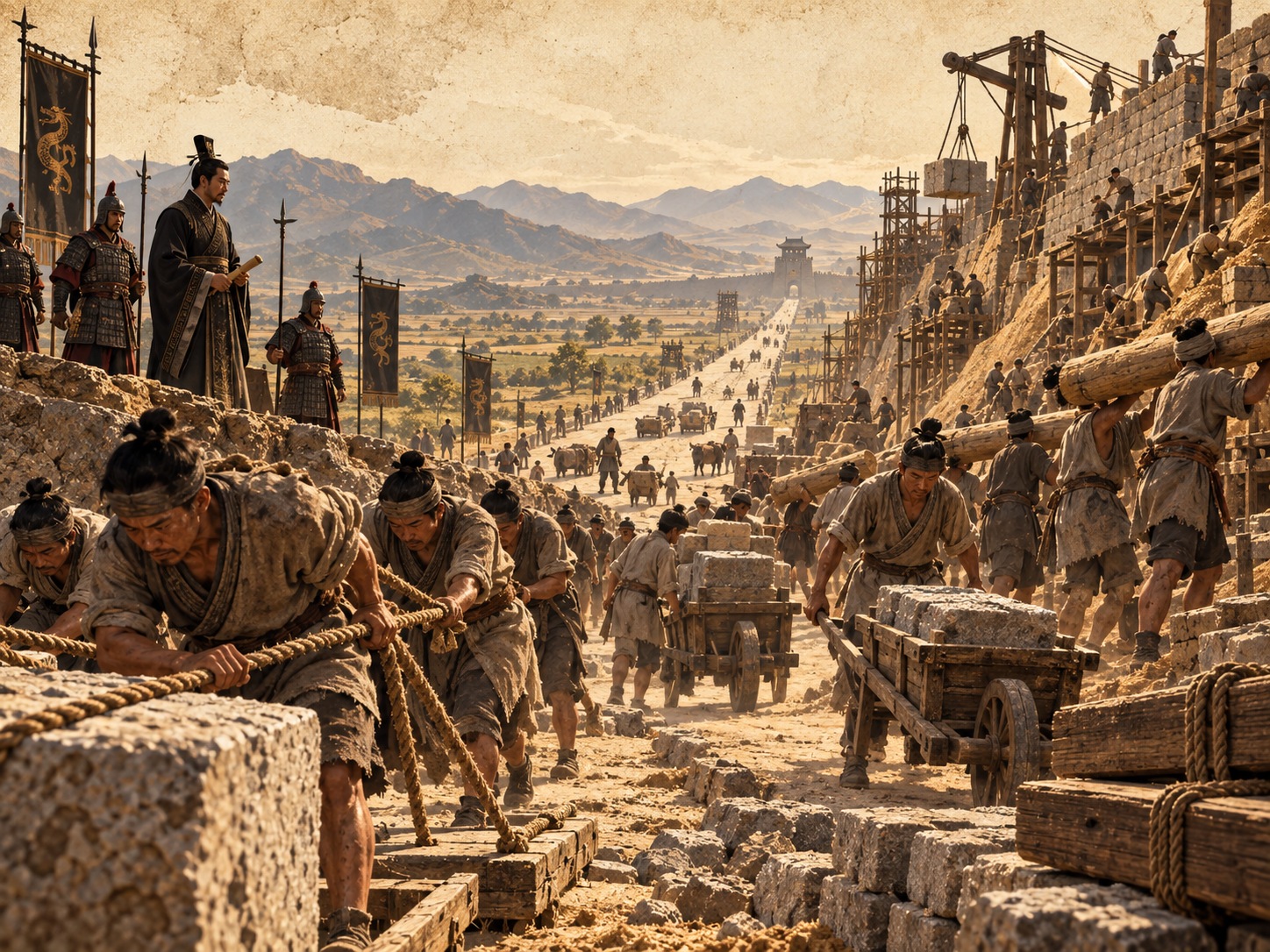
Conceptual illustration: corvée labor on a state construction project. Actual Qin projects varied widely in scale and organization.
4. The State Also Produced Things Itself
Another easily overlooked resource base was direct state production: official farmland and government-run workshops.
The Yuelu manuscripts include regulations known as the Xianguantian Ling, or “Ordinance on County Government Fields.” They address the allocation of labor and draft animals, irrigation, harvesting, management, and official responsibility. Output from government fields could be directly controlled by the state, unlike ordinary land rent, which was collected after private cultivation.
Qin also operated a large system of state workshops. Statutes such as the Gong Lü, Gongren Cheng, and Jungong in the Shuihudi corpus regulated craft production, labor organization, quality, and standardization.
So the Qin government was not merely sitting in Xianyang waiting for taxes to arrive. It was a collector, land manager, warehouse operator, production organizer, and one of the largest consumers of military supplies in the empire.
5. Commerce Was Taxed Too—but It Was Not the Main Pillar
Qin had a developed system of market regulation. The Shuihudi statutes include rules concerning markets, currency, trade, and fiscal administration. Commercial activity was therefore supervised and could generate state revenue.
But modern urban economies can mislead us. In a society where agriculture dominated employment and output, land and registered households remained the fundamental fiscal base. Commercial revenue supplemented that foundation rather than replacing it.
This is why premodern states cared so intensely about land, households, and farming. A single peasant household could simultaneously represent food supply, taxable capacity, labor power, and military manpower.
6. Fines, Redemption Payments, and Confiscation
Qin law was famously detailed. Administrative failure, arrears, defective production, and many other violations could lead to penalties. Some penalties took the form of money, redemption payments, equipment, or confiscated property, so the legal system could indeed produce material revenue.
But Qin should not be described as a state financed mainly by fines. Its fiscal core was still land, households, agricultural goods, and compulsory labor.
The more important fiscal function of law was enforcement. Arrears had to be pursued. Officials responsible for collection could be punished for failure. Grain entering or leaving warehouses had to be recorded, and government property was subject to verification. Tax rates were only one component of the system; registration, collection, transport, storage, accounting, and accountability formed the infrastructure that made extraction work.
7. Qin’s Real Secret: Turning People, Land, and Grain into Quantifiable State Resources
Why did Qin become so formidable after the reforms associated with Shang Yang? Military institutions, county administration, land arrangements, and legal rules all mattered. From a fiscal perspective, however, another answer deserves emphasis: Qin became unusually good at knowing what resources it possessed.
How many households? How many people? How much cultivated land? How much grain and fodder could be collected? Who owed service? How much remained in government stores? Which official was responsible for each task?
Once such information was continuously recorded, a dispersed agrarian society began to resemble a vast ledger of state resources.
The deepest consequence of unification was therefore not only common currency, weights and measures, or writing conventions. It was also the creation of a more direct administrative chain linking the center to commanderies, counties, local communities, and registered households.

Conceptual illustration: grain, labor, and transport moving from local production toward state warehouses and administrative centers.
8. If the Fiscal Machine Was So Strong, Why Did Qin Last So Briefly?
This is one of the great paradoxes of Qin history. Strong fiscal capacity does not mean society can sustain unlimited mobilization.
After unification, the empire continued to undertake frontier wars, road building, defensive works, palaces and mausoleums, forced migrations, and administrative expansion. Every project demanded grain, transport, and labor.
An inefficient fiscal machine leaves the state unable to act. But a highly efficient machine, if kept at wartime intensity for too long, can also generate severe social strain precisely because it is capable of extracting so much.
So it is too simple to say that Qin fell merely because “taxes were high.” A more precise interpretation is that Qin built an extraordinarily powerful mobilization system but failed to recalibrate it quickly enough for a sustainable post-unification order. State capacity rose faster than society’s ability to absorb continuous demands.
9. Qin Finance in Modern Terms
Modern public finance is measured mainly in monetary flows. Qin’s effective resource base was broader: grain + money + land + materials + labor + soldiers.
That is why the question “How did the Qin government make money?” is slightly anachronistic. For Qin, the decisive issue was not how many coins sat in a treasury, but whether the government could mobilize resources when it needed them.
Qin’s strength was therefore organizational as much as military.
Conclusion: Qin’s Most Lasting Legacy Was a Form of State Capacity
The unified Qin dynasty was short-lived, but many of its institutional legacies endured far longer: commanderies and counties, household registration, land records, taxation, corvée, bureaucracy, warehouses, and standardized administrative practices.
Together, these institutions created a new way of running a large territorial state. The central government became increasingly capable of knowing how many people, fields, and stores of grain existed—and how much could be mobilized when necessary.
That capacity helped Qin conquer its rivals and sustain an unprecedented empire. But Qin’s collapse also carried a warning: stronger fiscal capacity does not grant a state an unlimited claim on society.
The hardest question for any powerful fiscal system is not, “How much more can the state take?” It is, “How much can it take while leaving society able to keep producing, living, and recovering?”
Qin did not solve that balance well. More than two millennia later, the tension between state capacity and social sustainability remains one of the most useful ways to think about public finance and governance.
Sources and Note
1. 中国社会科学网:《岳麓秦简新资料 秦律秦令研秦史》 https://www.cssn.cn/kgxc/kgxc_kgsb/202207/t20220728_5431108.shtml
2. 全国哲学社会科学工作办公室:《里耶秦简所载秦代基层行政与社会治理》 https://www.nopss.gov.cn/n1/2026/0525/c219544-40726576.html
3. 中国社会科学网:《岳麓简所记秦代官田管理法规》 https://www.cssn.cn/skgz/bwyc/202506/t20250611_5878616.shtml
4. 秦风网(来源:学习时报):《从云梦睡虎地秦简看秦代法制文明》 https://www.qinfeng.gov.cn/info/1064/234023.htm
Note: This is a public-facing interpretation of Qin fiscal history. “Revenue” and “making money” are used in a broad resource-mobilization sense that includes payments in kind, corvée labor, and military manpower as well as coin. All illustrations are AI-generated conceptual reconstructions intended for explanation, not archaeological reproductions of Qin clothing, architecture, or administrative scenes.
Why Progress Gets Stuck
Medicine reveals why scientific knowledge does not automatically become affordable, scalable improvements in everyday life.

How Singapore Governs
How parliamentary government, professional administration, open markets, fiscal rules, compulsory savings and public housing reinforce one another.

Singapore: From Strait Port to Global City-State
How a small island converted location into connectivity—and connectivity into state capacity.