How Singapore Governs
How parliamentary government, professional administration, open markets, fiscal rules, compulsory savings and public housing reinforce one another.

Singapore is best understood not as a single policy success, but as a system of mutually reinforcing institutions: parliamentary government, a strong executive, professional administration, open markets, public asset ownership, compulsory savings and asset-based welfare.
Singapore is often described through shorthand labels: a free-market hub, a technocratic state, a low-tax economy, a public-housing success, or a dominant-party democracy. Each description captures something real. None, on its own, explains how the system works.
The more useful way to understand Singapore is to examine institutional complementarity. Political continuity makes long-horizon planning easier. A professional public service and specialised statutory boards translate strategy into execution. Open markets generate income and investment. CPF converts part of wage income into compulsory household savings. HDB converts part of those savings into housing assets. Fiscal rules and sovereign investment preserve capital across generations. The model is therefore less about “big government” or “small government” than about how the state structures incentives.
1. A parliamentary system with a strong executive centre
Singapore is a parliamentary republic in the Westminster tradition. The President is the head of state, while the Prime Minister is the effective head of the executive. The Cabinet is the central decision-making body of government and is collectively responsible to Parliament. This creates a short chain between parliamentary majority, executive decision and administrative implementation.
The presidency nevertheless has an unusual constitutional role. Singapore distinguishes between reserves accumulated by the current government and Past Reserves accumulated by previous governments. Under the “Two-Key” framework, the elected President can veto specified attempts to draw on Past Reserves and exercises safeguards over selected key appointments. The purpose is not to create a rival executive, but to protect intergenerational assets from short-term political incentives.
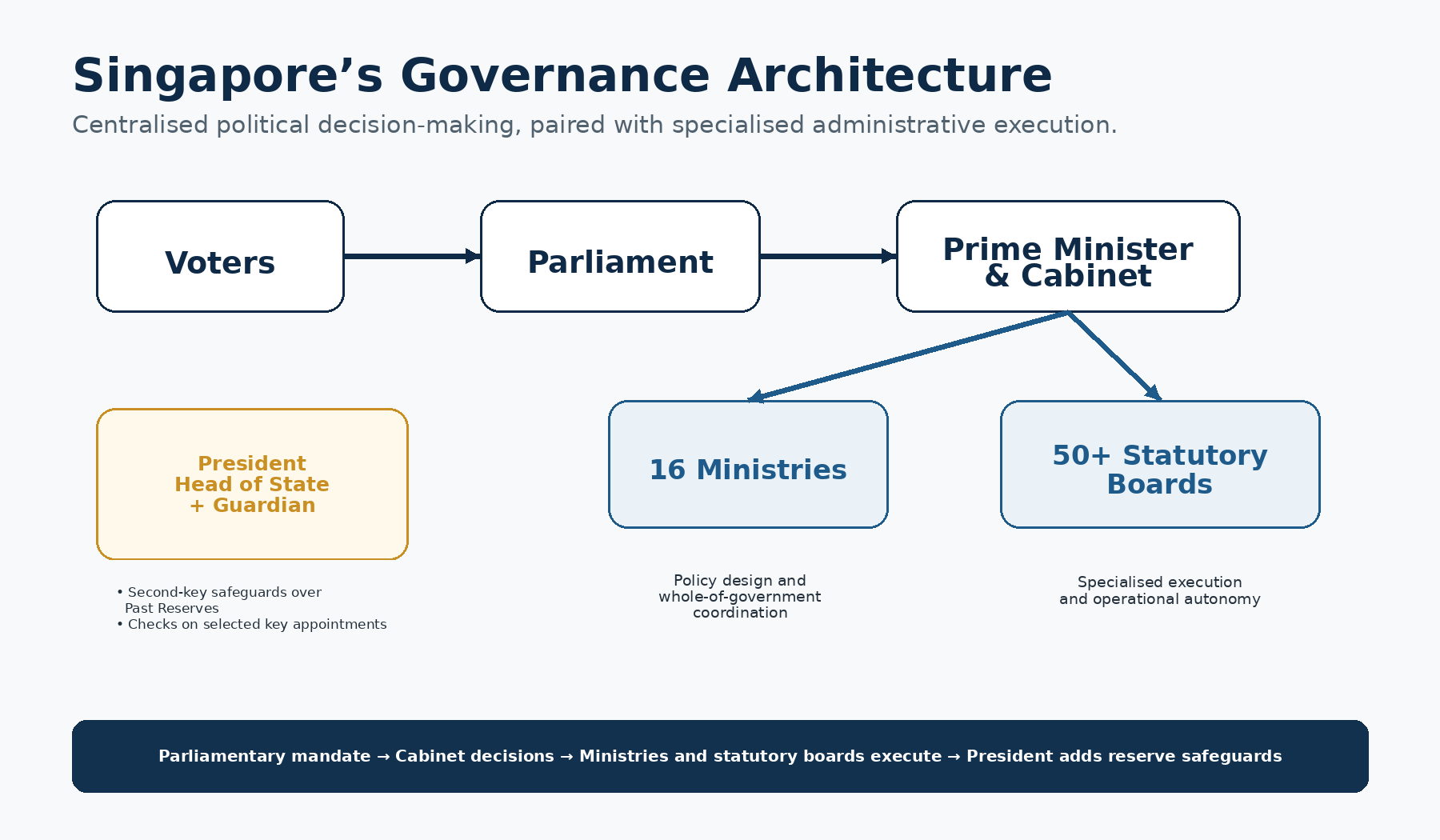
Figure 1 | Singapore’s governance architecture: centralised strategic decision-making with specialised execution.
2. Dominant-party politics and policy continuity
Singapore holds regular elections and has opposition representation, yet the People’s Action Party has remained the dominant governing party for decades. The practical consequence is unusually high policy continuity. Infrastructure, housing, industrial strategy and urban planning can be pursued over long horizons without frequent changes in the governing coalition.
This continuity reduces policy-reversal risk for both the state and private investors. It also creates a trade-off: lower turnover in political power places greater weight on institutional checks, public accountability and the government’s ability to sustain legitimacy through performance. Singapore therefore cannot be evaluated solely by administrative efficiency; the balance between continuity, contestation and participation is part of the model itself.
3. State capacity through ministries and statutory boards
A defining organisational feature is the extensive use of statutory boards. Singapore’s Public Service spans 16 ministries and more than 50 statutory boards. Public information in 2026 puts the Public Service at roughly 158,000 officers, including around 89,000 Civil Service officers in ministries.
Statutory boards are legally distinct employers with their own recruitment and human-resource practices. This matters because modern public tasks—housing development, financial regulation, industrial estates, transport, utilities and investment promotion—often require specialised expertise and operational flexibility. The result is a system in which strategy is relatively centralised, while implementation is distributed across professional organisations.
4. A developmental market economy
Singapore is deeply market-oriented: trade, foreign investment, multinational firms, private enterprise and global finance are central to its prosperity. Yet the state has a major role in land, infrastructure, housing, finance and long-term capital. This is why the economy is better described as a developmental market economy than as laissez-faire capitalism.
The state does not normally decide how many units a private firm should produce. Instead, it shapes the conditions under which investment occurs: industrial land, ports, airports, skills, research, taxation, immigration rules and connectivity. Agencies such as EDB and JTC operate at this boundary between public strategy and private investment. Temasek and GIC add another layer: the state is not only a regulator and tax collector, but also a long-term owner and investor of capital.
5. Fiscal constitutionalism and the protection of reserves
Singapore’s fiscal framework is notable for treating the public balance sheet as an intergenerational institution. Past Reserves are constitutionally protected, limiting the ability of a current government to turn accumulated national wealth into immediate political spending. This addresses a classic time-consistency problem: voters and governments can enjoy current expenditure while shifting costs into the future.
At the same time, reserves are invested rather than left idle. A portion of long-term investment returns can support the budget under established fiscal rules. In effect, previous generations’ savings become productive capital, part of whose returns help finance present public expenditure while the principal remains protected. This gives Singapore more fiscal resilience than annual tax revenue alone would provide.
6. CPF and asset-based welfare
Singapore’s social model differs sharply from high-tax European welfare states. The Central Provident Fund is a compulsory savings system linked to housing, healthcare and retirement. In 2026, for covered employees aged 55 and below earning more than S$750 a month, the combined CPF contribution rate is 37% of wages: 17% from the employer and 20% from the employee.
The institutional idea is important. Rather than relying only on future government transfers, workers accumulate balances in accounts assigned to long-term needs. The state still redistributes and subsidises, particularly for lower-income households and vulnerable groups, but the baseline social contract puts a strong emphasis on individual asset accumulation through employment.
7. HDB as housing policy, social policy and balance-sheet policy
Housing is where Singapore’s social and economic systems meet. In 2025, 77.2% of resident households lived in HDB dwellings. The latest available tenure figure shows that 90.8% of resident households were owner-occupiers in 2024. These numbers make home ownership more than a housing outcome; it is a central part of household wealth formation.
CPF savings can be used for housing, while HDB supplies housing at national scale. The combination converts labour income into a durable household asset. This is why scholars often describe the model as asset-based welfare: social security is partly delivered through ownership of assets rather than only through recurring cash benefits.
The model also has limits. Rising property values can widen intergenerational inequality, high entry prices can burden younger households, and retirement security becomes partly exposed to housing-market conditions. Asset-based welfare therefore requires continuous recalibration rather than passive reliance on property appreciation.
8. Tripartism and coordinated labour relations
Singapore’s tripartite framework brings together the Government, the National Trades Union Congress and the Singapore National Employers Federation. It institutionalises cooperation over wages, workforce upgrading, employment practices and labour-market adjustment. The National Wages Council is one well-known example of this approach.
Tripartism does not eliminate conflicts of interest. It changes the way they are processed. In a small open economy, firms must remain internationally competitive, while workers need wage growth and security. The tripartite model seeks negotiated adjustments rather than repeated confrontation. Its strength depends heavily on trust and organisational coordination—conditions that cannot simply be legislated into existence elsewhere.
9. The institutional flywheel
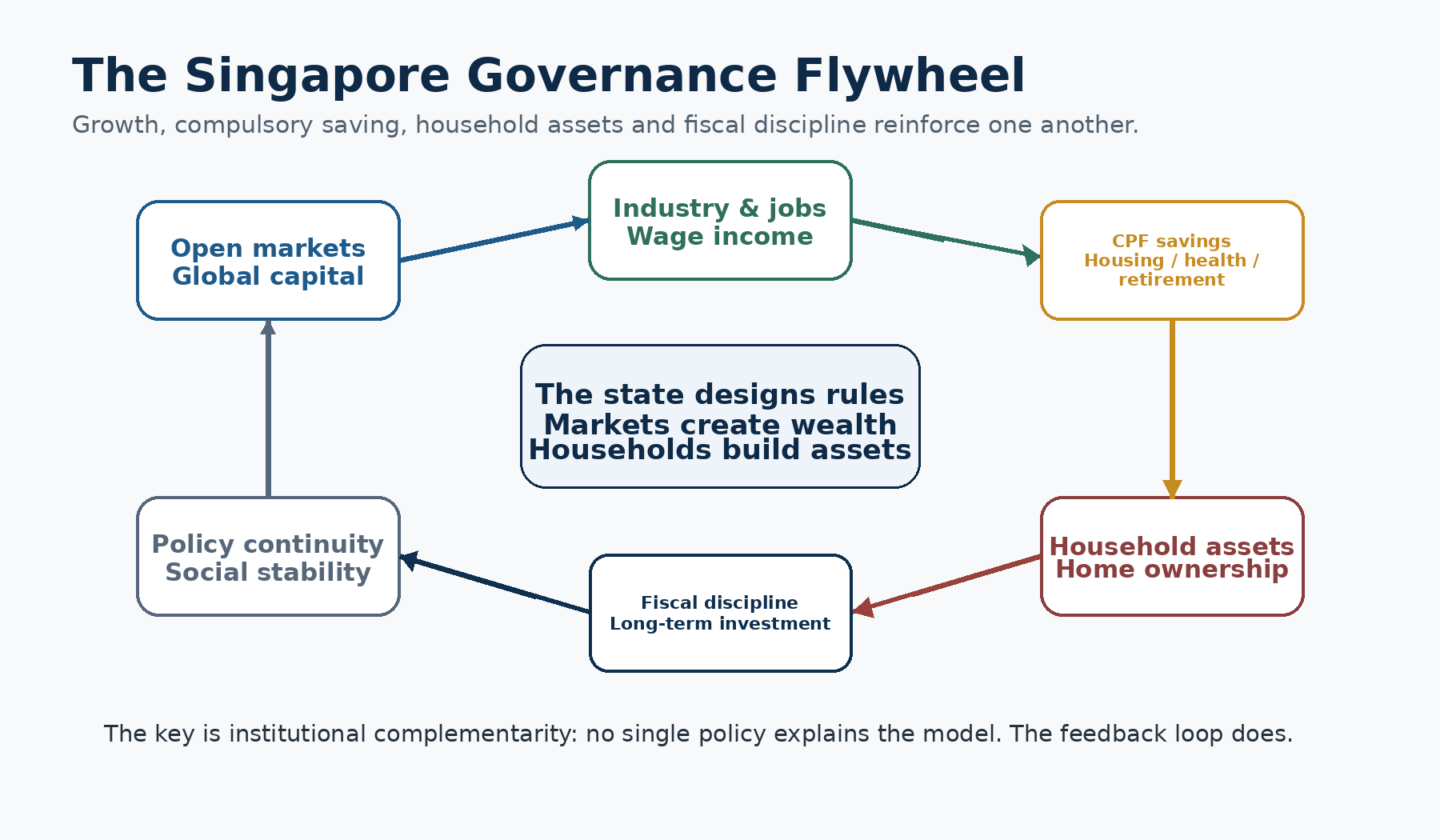
Figure 2 | The Singapore governance flywheel: growth, savings, assets, fiscal discipline and policy continuity reinforce one another.
The model can be expressed as a feedback loop. Open markets generate investment and jobs. Jobs generate wages and CPF contributions. CPF supports housing, healthcare and retirement savings. HDB helps convert savings into household assets. Household asset ownership strengthens the social importance of stability and long-term economic performance. Fiscal discipline and investment preserve national capital. Political continuity then supports the next round of long-horizon planning.
This is why copying a single Singaporean institution is often misleading. HDB without land policy and CPF can become fiscally unsustainable. Industrial policy without administrative quality and external competition can become rent-seeking. Sovereign investment without strong institutions can become opaque political finance. The parts work because the surrounding system constrains and complements them.
10. What is transferable—and what is not
Singapore is a city-state with a distinctive geography, colonial history, port economy, demographic scale and administrative tradition. Its relatively compact territory reduces coordination costs and allows the government to observe policy outcomes quickly. Large federal or highly decentralised countries operate under very different constraints.
What may be more transferable are principles rather than institutions: protect long-term public assets from short-term political incentives; invest in professional execution capacity; make agencies accountable for clearly defined outcomes; and design social policy so that economic growth, household security and public finance reinforce rather than undermine one another.
Conclusion
Singapore’s defining feature is not simply a strong state. It is a state that tries to engineer compatibility between markets, public institutions and household incentives.
References
- Prime Minister’s Office Singapore, “The Government” and “The Cabinet”. https://www.pmo.gov.sg/about-us/the-government/ | https://www.pmo.gov.sg/about-us/the-cabinet/
- Ministry of Finance Singapore, “How are Past Reserves protected?” https://www.mof.gov.sg/policies/reserves/how-are-past-reserves-protected/
- Public Service Division / Careers@Gov, Singapore Public Service structure and headcount. https://www.careers.gov.sg/who-we-are/the-singapore-public-service/
- Central Provident Fund Board, CPF contribution rates from 1 January 2026. https://www.cpf.gov.sg/employer/employer-obligations/how-much-cpf-contributions-to-pay
- Singapore Department of Statistics, Resident Households / Population Trends 2025. https://www.singstat.gov.sg/find-data/search-by-theme/households/resident-households
- Housing & Development Board, HDB Key Statistics 2024/2025. https://www.hdb.gov.sg/-/media/hdb-pulse/reports/annual-reports-and-financial-statements/HDB_Key-Statistics-2025.pdf
- Ministry of Manpower Singapore, “What is tripartism”. https://www.mom.gov.sg/employment-practices/tripartism-in-singapore/what-is-tripartism 说明:文中涉及2026年CPF缴费率、公共服务规模、Past Reserves机制、2025年HDB居住结构与2024年住房自有率等数据,均以新加坡官方公开资料为准。不同统计指标的参考期并不完全一致,文中已按原始口径标注年份。
Why Progress Gets Stuck
Medicine reveals why scientific knowledge does not automatically become affordable, scalable improvements in everyday life.
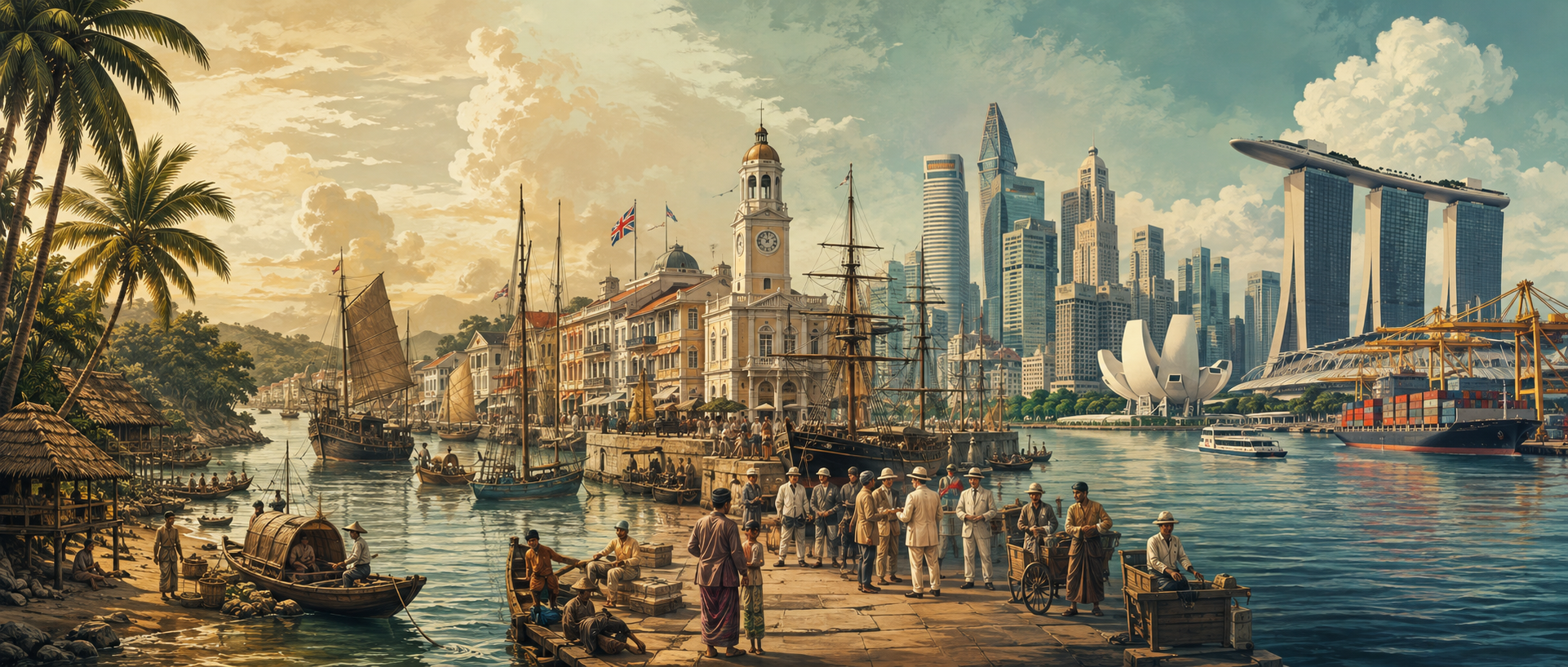
Singapore: From Strait Port to Global City-State
How a small island converted location into connectivity—and connectivity into state capacity.

An Economic History of France
How France evolved from an agrarian kingdom into a modern economy through royal finance, revolution, industrialization, state planning, welfare, and high-value industry.