Morning Briefing: Greenspan, SpaceX, Hormuz Strait, and the Global Economy
Alan Greenspan dies at 100, SpaceX sheds $400bn, 400+ ships queue near Hormuz, and America's allies look to go independent — a round-up of the day's top economic stories.
1. Alan Greenspan Dies at 100 — The Fed’s Legendary Chairman
Alan Greenspan, who presided over the US Federal Reserve for nearly two decades (1987–2006), died on June 22 at the age of 100 in Washington, D.C.
Greenspan’s tenure defined what economists call the “Great Moderation” — an era of low inflation, steady growth, and financial innovation. He left office just before the Great Recession, and in many ways the post-2008 debate about central banking is a debate about his legacy.
His admirers credit him with navigating the 1987 stock market crash, the Asian financial crisis, the dot-com bust, and 9/11’s economic aftermath. His critics point to his deregulatory philosophy — particularly around derivatives and mortgage lending — as a root cause of the 2008 financial collapse. In a famous 2008 congressional hearing, Greenspan admitted: “I found a flaw in the model that I perceived is the critical functioning structure of how the world works.”
Barry Eichengreen, writing for Project Syndicate, sums up the legacy: “Greenspan’s great gift was his ability to read the economy in real time. His great failing was believing that markets could read themselves.” [1][2]
2. SpaceX Loses $400 Billion in Value
SpaceX’s public-market debut honeymoon is over. The rocket and satellite company has shed approximately $400 billion in market value as the initial rally reversed course.
At its peak, SpaceX was valued at over $1 trillion — making it the most valuable private company ever to go public. The reversal reflects a broader recalibration of expectations around the space economy:
- Starship’s fully reusable launch system remains unproven at scale
- Starlink’s revenue growth, while real, has not accelerated as quickly as early projections
- Competition is mounting from Blue Origin, Rocket Lab, and Chinese private launch providers
The correction may be healthy. It forces the market to focus on SpaceX’s real competitive moats: its cost per launch advantage, government contract relationships, and Starlink’s growing but still maturing subscriber base. [3]
3. 400 Ships Waiting Near the Strait of Hormuz
Over 400 commercial vessels are queued outside the Strait of Hormuz, the world’s most critical oil chokepoint, as shipping lanes gradually reopen following diplomatic progress between the US and Iran.
About 20% of the world’s petroleum passes through the strait. During the height of tensions, shipping insurance premiums surged several-fold, and many carriers diverted to longer routes. The backlog now represents weeks — possibly months — of accumulated cargo demand.
If full navigation resumes, oil prices could see short-term downward pressure. But the structural question remains: the crisis has reminded global supply chains how dangerously concentrated one strategic chokepoint can be. Diversification plans that were discussed but delayed are now being taken seriously again. [4]
Mohamed A. El-Erian, writing for Project Syndicate, cautions: “An agreement is a necessary first step, but the market’s reaction will depend on implementation, verification, and whether the broader architecture of regional security is addressed.” [5]
4. America’s Allies Start Looking Elsewhere
The Financial Times published a deep analysis of a quiet structural shift: America’s traditional allies are re-evaluating their dependence on Washington.
From European defense autonomy (the EU’s push for a joint military command structure) to Japan and South Korea’s strategic rebalancing, the post-WWII alliance system is showing its first significant cracks. The drivers are familiar:
- US foreign policy unpredictability
- Lingering effects of Trump-era trade friction
- A multi-polar world where “strategic autonomy” has become a mainstream ambition from Paris to Tokyo
For investors and policymakers, this means a more fragmented geopolitical landscape — one where old alliances no longer guarantee automatic alignment, and new coalitions (like the expanding BRICS+) create alternative centers of gravity. [6]
5. Food Security Lessons from the Iran Conflict
The Iran conflict exposed a deep vulnerability in the global food system: modern agriculture depends on a handful of exporting countries, reliable shipping lanes, and just-in-time fertilizer supply chains.
Maximo Torero, writing for Project Syndicate, argues that the real risk isn’t production shortfall — global food output remains adequate — but concentration risk. A small number of countries control most of the world’s grain exports. When geopolitical conflict cuts one of those lines, price shocks cascade to the world’s most vulnerable populations almost instantly.
His recommendation: regional food reserves and emergency stockpiling mechanisms that can operate independently of global trade flows. In a world where conflict can shut a strait overnight, the cheapest insurance is redundancy. [7]
6. The Global Carbon Pricing Map
Our World in Data released an interactive map showing what people around the world actually pay for their carbon emissions.
The data reveals a stark divide:
- Western Europe: Carbon prices of €50–100 per tonne (EU ETS + national carbon taxes)
- Most of the US: Zero (no federal carbon price; state-level programs cover only pockets of the economy)
- China, India, and most of the developing world: Zero or near-zero
The gap is both a policy failure and an opportunity. As the EU’s Carbon Border Adjustment Mechanism (CBAM) comes into effect, countries with no carbon price will face increasing trade friction. The map makes one thing clear: the world is not even close to a unified carbon price, but the direction of travel is unmistakable. [8]
Sources:
[1] Financial Times — Alan Greenspan dies aged 100
https://www.ft.com/content/e26ebf11-2288-4913-96f3-001f6065755a
[2] Project Syndicate — Alan Greenspan’s Mixed Legacy, Barry Eichengreen
https://www.project-syndicate.org/commentary/alan-greenspan-fed-chair-mixed-legacy-by-barry-eichengreen-2026-06
[3] Financial Times — SpaceX sheds $400bn in market value as debut rally hits reverse
https://www.ft.com/content/c11d08ed-6668-4678-b829-1d50acbd12d4
[4] Financial Times — Over 400 ships are waiting near Hormuz for the strait to reopen fully
https://www.ft.com/content/9df718a9-8ee3-4d8b-a9ff-a29263d35a88
[5] Project Syndicate — The US-Iran Agreement Is a First Step, Mohamed A. El-Erian
https://www.project-syndicate.org/commentary/us-iran-agreement-only-first-step-for-markets-and-global-economy-by-mohamed-a-el-erian-2026-06
[6] Financial Times — America’s allies look to declare independence from the US
https://www.ft.com/content/a718bd51-c56e-4d02-b23f-028c7936bab2
[7] Project Syndicate — What the Iran War Taught the World About Food Security, Maximo Torero
https://www.project-syndicate.org/commentary/iran-war-exposed-global-agriculture-lack-of-resilience-by-maximo-torero-2026-06
[8] Our World in Data — How much are people across the world paying for their carbon emissions?
https://ourworldindata.org/how-much-are-people-across-the-world-paying-for-their-carbon-emissions
Is Italy Really Rich? Growth, Jobs, Population, Education and the North–South Divide
Italy is wealthy but slow, resilient but divided. A comprehensive look at its economy, labour market, demographics, education, welfare system and the persistent North–South gap.
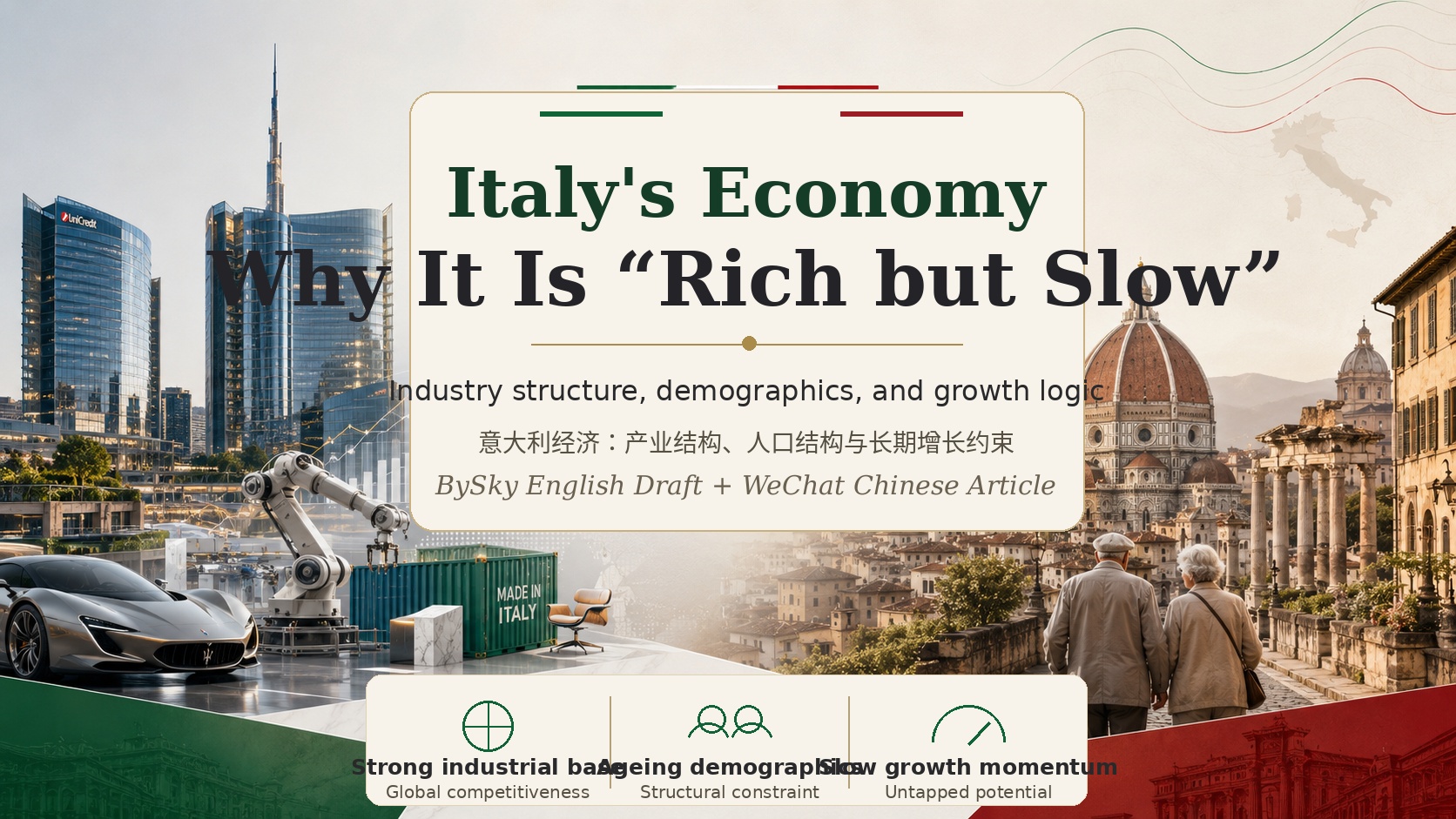
Italy's Economy Is Rich, Skilled — and Getting Old
Italy is a wealthy, advanced economy with deep industrial capabilities, world-class brands, a powerful tourism engine — and one of the oldest populations in Europe.
The SpaceX IPO Was the Signal. Hard Tech Is the Story.
SpaceX's record-breaking $160 debut created the first trillionaire and turned thousands of engineers into millionaires. But the real story is what it means for capital markets and hard tech startups.