Italy's Economy Is Rich, Skilled — and Getting Old
Italy is a wealthy, advanced economy with deep industrial capabilities, world-class brands, a powerful tourism engine — and one of the oldest populations in Europe.
Italy is easy to romanticize.
For travelers, it is Rome, Florence, Venice, Milan, pasta, museums, fashion, churches, and crowded train stations. For economists, however, Italy is something more complicated: a wealthy, advanced economy with deep industrial capabilities, world-class brands, a powerful tourism engine — and one of the oldest populations in Europe.
The simplest way to describe Italy is this: services keep the economy running, manufacturing gives it global relevance, tourism brings cash and visibility, and demographics slow everything down. That is why Italy often feels both prosperous and stagnant at the same time.
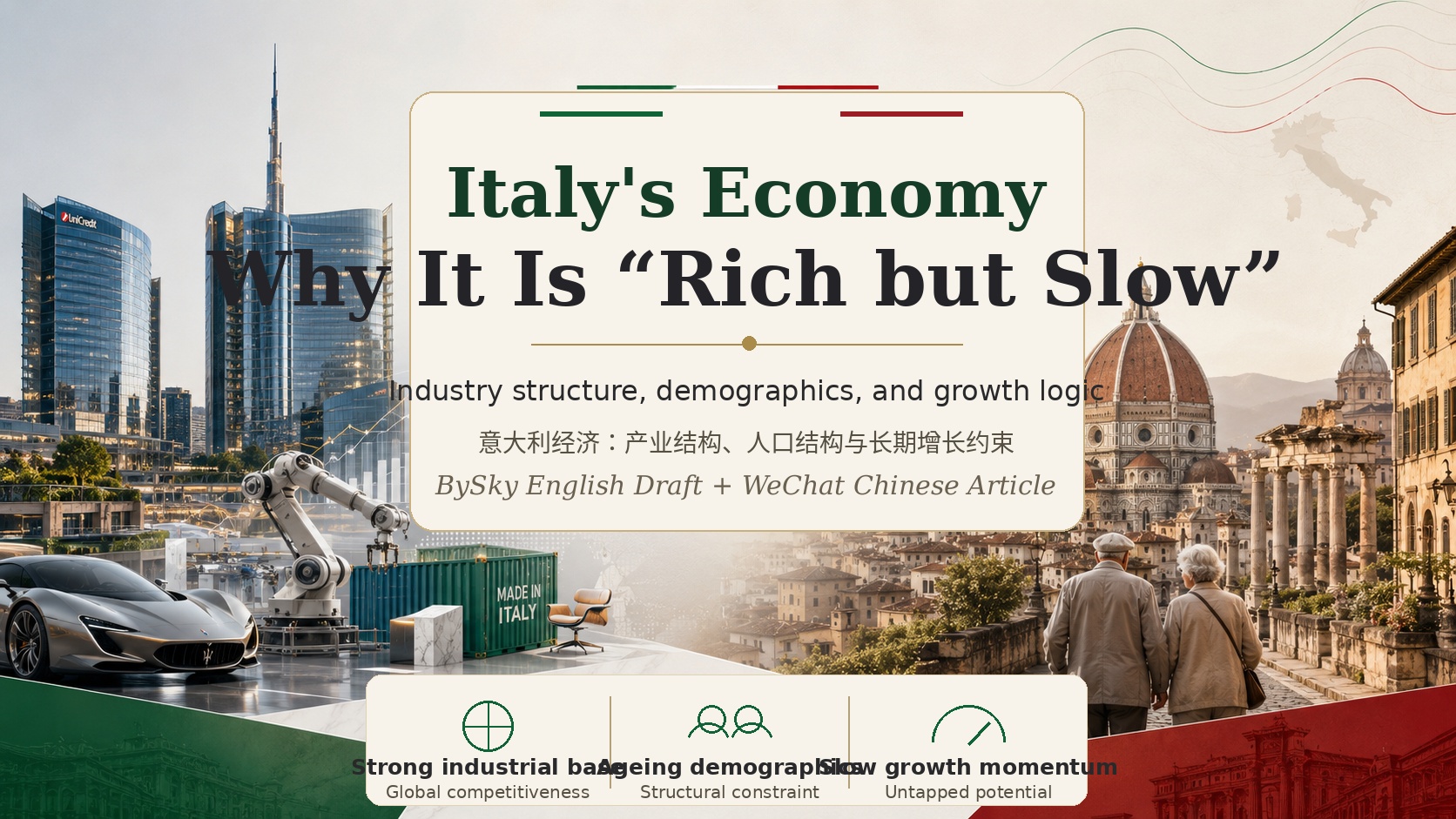
1. Italy is not poor. It is slow.
Italy’s problem is not the absence of wealth. It is the lack of growth momentum. The OECD describes Italy’s economy as resilient after recent global shocks, but says its medium-term prospects are weighed down by high public debt, population ageing, trade uncertainty, geopolitical risks, and stronger international competition. OECD projections put Italy’s GDP growth at around 0.5% in 2026 and 0.6% in 2027. [6]
In other words, Italy is not collapsing. It is not booming either. It is a mature economy moving slowly under the weight of its own structure.
2. The industrial structure: services dominate, but manufacturing still matters
Italy is a service-led economy, as most advanced economies are. But it is not just a tourism economy.
| Sector | Approx. share of GDP (2024) | What it means |
|---|---|---|
| Services | Around 65.05% | Tourism, finance, retail, logistics, culture, hospitality |
| Industry (incl. construction) | Around 21.71% | Manufacturing, energy, construction, industrial supply chains |
| Manufacturing | Around 14.55% | Machinery, vehicles, pharmaceuticals, fashion, furniture, food processing |
| Agriculture, forestry and fishing | Around 2.03% | Wine, olive oil, cheese, fruit, vegetables, specialty foods |
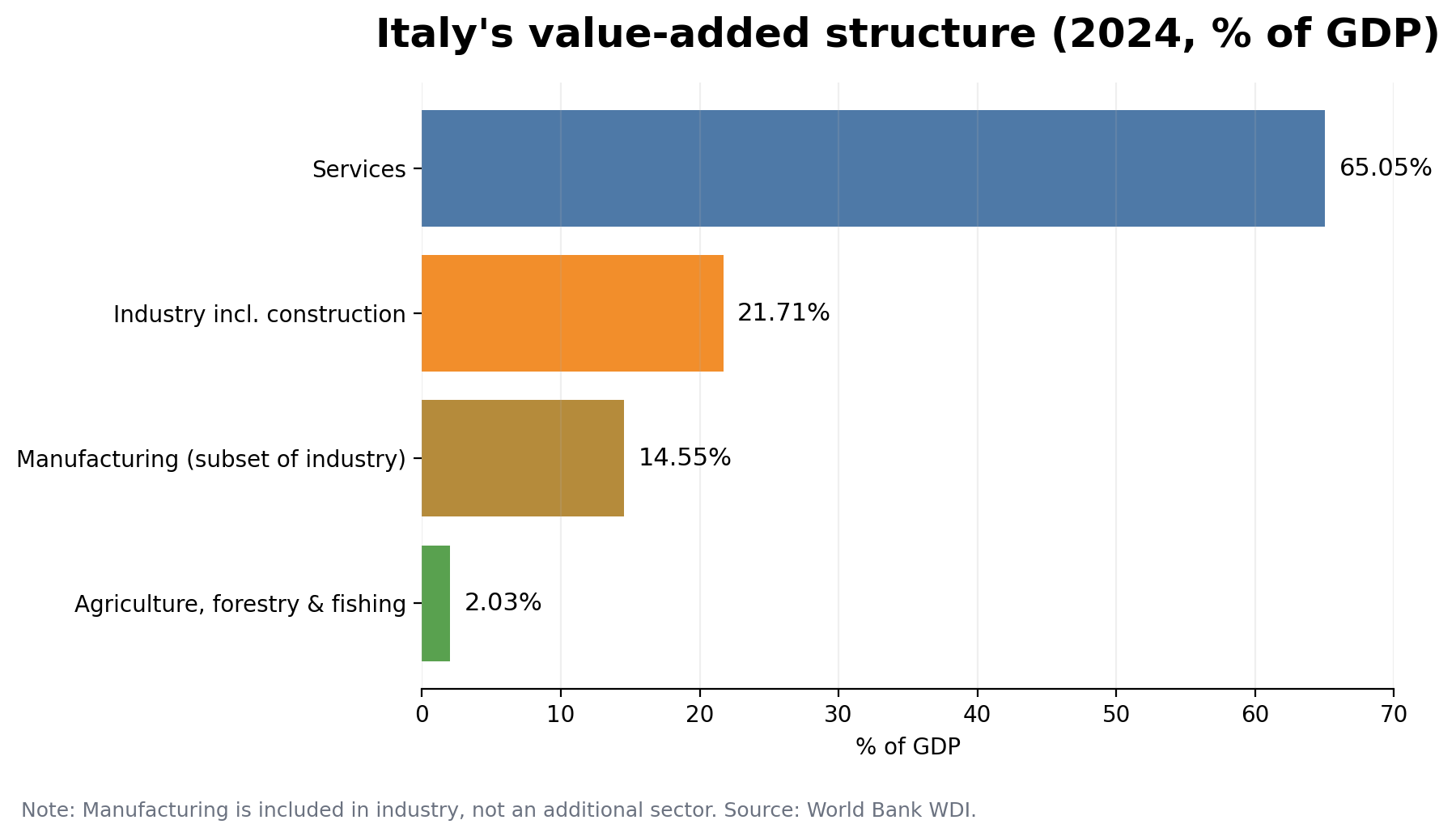
Figure 1: Italy’s value-added structure. Manufacturing is part of industry, not an additional sector.
The most interesting part is manufacturing. Italy does not compete mainly on cheap mass production. It competes on design, quality, specialization, craftsmanship, and brand value. Think of machinery, packaging equipment, food-processing machines, furniture, ceramics, leather goods, apparel, car parts, luxury products, and premium food exports.
Germany’s industrial model is associated with large engineering groups. Italy’s model is different: smaller firms, family ownership, local clusters, and highly specialized know-how. According to the OECD, Italy has more than 4 million small and medium-sized enterprises, the largest number among EU member states. These SMEs employ around 13 million people and generate more than 65% of national added value. [2]
3. Tourism is not the whole economy, but it is a major anchor
Tourism is one of Italy’s strongest advantages. According to the World Travel & Tourism Council, Italy’s travel and tourism sector contributed about €215 billion in 2023, equal to 10.5% of the country’s total economic output. The sector supported around 2.97 million jobs, roughly one in every eight jobs nationwide. [3]
This is why Italian cities feel commercially alive. Hotels are expensive. Restaurants are busy. Museums require reservations. Historic centers are crowded. Local businesses depend heavily on foreign visitors.
Tourism turns cultural heritage into cash flow. But it also creates pressure: higher rents, higher restaurant prices, crowded city centers, and a growing conflict between residents and visitors in popular destinations. Tourism is both Italy’s gift and its burden.
4. Demographics: the real long-term constraint
If the industrial structure explains why Italy is rich, demographics explain why Italy grows slowly. According to ISTAT, Italy’s resident population was about 58.94 million as of January 1, 2026. The population looks stable, but only because positive net migration offsets a deeply negative natural balance. In 2025, Italy recorded about 355,000 births and 652,000 deaths. Its fertility rate fell to 1.14 children per woman. [4]
| Indicator | Latest figure |
|---|---|
| Total resident population | Around 58.94 million |
| Births in 2025 | Around 355,000 |
| Deaths in 2025 | Around 652,000 |
| Fertility rate | 1.14 children per woman |
| Population aged 0–14 | 6.85 million, 11.6% |
| Population aged 15–64 | 37.27 million, 63.2% |
| Population aged 65+ | 14.82 million, 25.1% |
| Population aged 85+ | 2.51 million, 4.3% |
| Foreign resident population | Around 5.56 million |
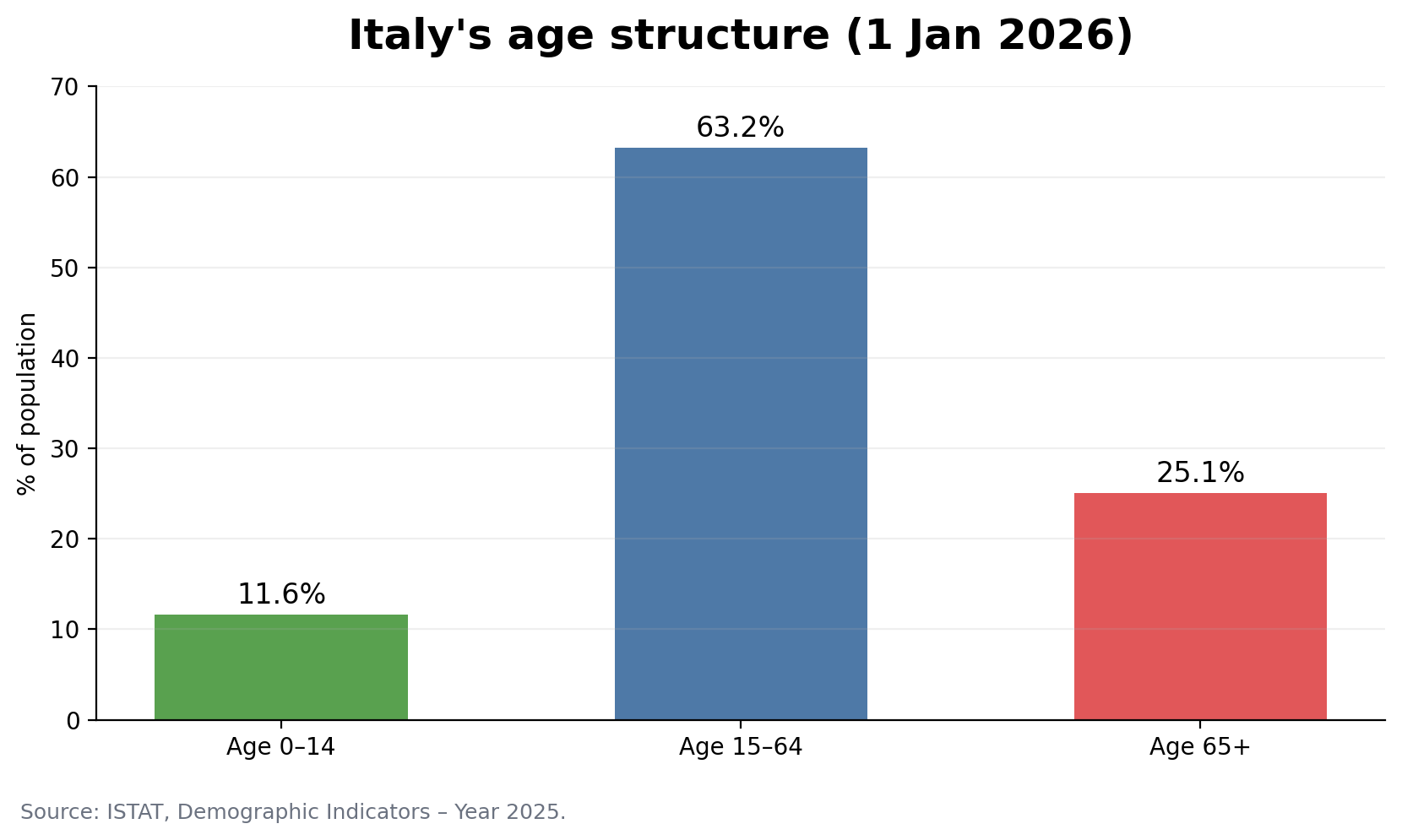
Figure 2: Italy’s age structure. Roughly one in four Italians is 65 or older.
Roughly one in four Italians is now 65 or older. ISTAT says Italy is one of the oldest countries in the EU by the share of people aged 65 and above. [5] That is not just a demographic statistic. It changes the entire economy.
5. How ageing shows up in the real economy
| Structural change | Real-world manifestation | Economic impact |
|---|---|---|
| Fewer young people and fewer working-age adults | Shortages in manufacturing, services, care, construction and hospitality | Higher labor costs and weaker expansion capacity |
| More elderly people | Higher pension, healthcare and long-term care spending | Fiscal pressure and less room for tax cuts or investment |
| Older consumption profile | More spending on healthcare, medicine, care and community services | Stable but less dynamic domestic demand |
| SME-based business structure | Strong craftsmanship but slower digitization and scaling | Slower productivity growth |
First, labor becomes scarce. A shrinking working-age population makes it harder for firms to hire workers. Manufacturing needs skilled technicians. Hotels and restaurants need service workers. Healthcare and elderly care need caregivers. Construction needs labor. This helps explain why services in Italy can feel expensive and sometimes inefficient.
Second, public finances become heavier. More elderly people mean more pressure on pensions, healthcare and long-term care. Italy already has high public debt. The OECD says public debt rose to over 137% of GDP in 2025. [6]
Third, consumption becomes older and steadier. Younger societies spend more on housing, education, childcare, technology and new household formation. Older societies spend more on healthcare, medicine, care services, housing maintenance and stable daily consumption. This does not destroy demand, but it makes demand less dynamic.
Fourth, innovation becomes harder. Italy’s SME-based economy is flexible and specialized, but it also faces limits. Small family firms can be excellent at craftsmanship and niche production, but they may struggle with digital transformation, large-scale R&D, platform strategies and access to capital.
6. The North-South divide
Italy also has a deep regional divide. Northern regions such as Lombardy, Veneto, Piedmont and Emilia-Romagna are more industrial, export-oriented and productive. Milan acts as a financial and business hub. Southern Italy, by contrast, has long faced weaker employment opportunities, lower productivity, weaker infrastructure and heavier dependence on tourism, agriculture, public-sector employment and fiscal transfers.
This creates two Italies inside one country: a northern Italy that looks like an advanced industrial economy, and a southern Italy that struggles with slower development and fewer opportunities. The divide weakens national productivity and encourages young people to move north or abroad.
7. Conclusion: Italy is rich but slow
Italy’s strengths are obvious: world-class cultural assets, a powerful tourism brand, high-quality manufacturing, premium consumer brands, specialized SMEs, deep household wealth and globally admired cities.
Its weaknesses are just as clear: an ageing population, very low fertility, shrinking labor supply, high public debt, slow productivity growth and a persistent North-South divide.
Italy is not a failed economy. It is a mature, heavy economy. It has enough wealth and industrial depth to remain resilient. But without stronger productivity, better youth employment, faster digital transformation and a more sustainable demographic path, it will continue to grow slowly.
The best one-sentence summary is this: Italy does not lack industries. It lacks growth momentum. It does not lack wealth. It lacks demographic energy.
References
[1] World Development Indicators: Services, value added (% of GDP) - Italy. World Bank. https://data.worldbank.org/indicator/NV.SRV.TOTL.ZS?locations=IT
[2] Empowering SMEs for digital transformation and innovation: The Italian way. OECD. https://www.oecd.org/en/blogs/2024/06/empowering-smes-for-digital-transformation-and-innovation-the-italian-way.html
[3] Travel & Tourism Injected €215BN into Italy’s Economy. World Travel & Tourism Council. https://wttc.org/news/travel-and-tourism-injected-215-euros-bn-into-italys-economy
[4] Demographic Indicators – Year 2025. ISTAT. https://www.istat.it/en/press-release/demographic-indicators-year-2025/
[5] Demographic Indicators – Year 2025, age structure and ageing. ISTAT. https://www.istat.it/en/press-release/demographic-indicators-year-2025/
[6] Italy: OECD Economic Outlook, Volume 2026 Issue 1. OECD. https://www.oecd.org/en/publications/2026/06/oecd-economic-outlook-volume-2026-issue-1_8be0dba6/full-report/italy_4e62ecd6.html
[7] Italy - Industry, Value Added (% of GDP). Trading Economics / World Bank. https://tradingeconomics.com/italy/industry-value-added-percent-of-gdp-wb-data.html
[8] Italy - Manufacturing, Value Added (% of GDP). Trading Economics / World Bank. https://tradingeconomics.com/italy/manufacturing-value-added-percent-of-gdp-wb-data.html
[9] Italy - Agriculture, Value Added (% of GDP). Trading Economics / World Bank. https://tradingeconomics.com/italy/agriculture-value-added-percent-of-gdp-wb-data.html
Is Italy Really Rich? Growth, Jobs, Population, Education and the North–South Divide
Italy is wealthy but slow, resilient but divided. A comprehensive look at its economy, labour market, demographics, education, welfare system and the persistent North–South gap.
Morning Briefing: Greenspan, SpaceX, Hormuz Strait, and the Global Economy
Alan Greenspan dies at 100, SpaceX sheds $400bn, 400+ ships queue near Hormuz, and America's allies look to go independent — a round-up of the day's top economic stories.

Nietzsche’s Philosophy
What remains when inherited sources of truth, morality, and meaning lose their authority?