Industrial Profits Rose 18.8%: AI Computing Is Becoming a Manufacturing Profit Driver
China's January-May industrial data shows that AI is moving from model hype into hardware, manufacturing, materials, and profit statements.
For much of the past year, AI has been discussed through the lens of models, apps, chatbots, agents, and productivity tools. But the latest industrial data points to a broader story: AI is no longer only a software phenomenon. It is increasingly visible in manufacturing orders, component demand, materials, and industrial profits.
On June 27, China’s National Bureau of Statistics reported that major industrial firms posted total profits of 3.14396 trillion yuan in the first five months of 2026, up 18.8% year on year. The computer, communications and other electronic equipment manufacturing sector recorded profit growth of 103.9%. Xinhua, citing the NBS interpretation, added that the electronics industry contributed 43.1% to overall industrial profit growth, supported by demand for high-end computing and memory products linked to the global AI boom.
The important point is simple: AI is not only an application-layer story. It is becoming a full industrial chain story.
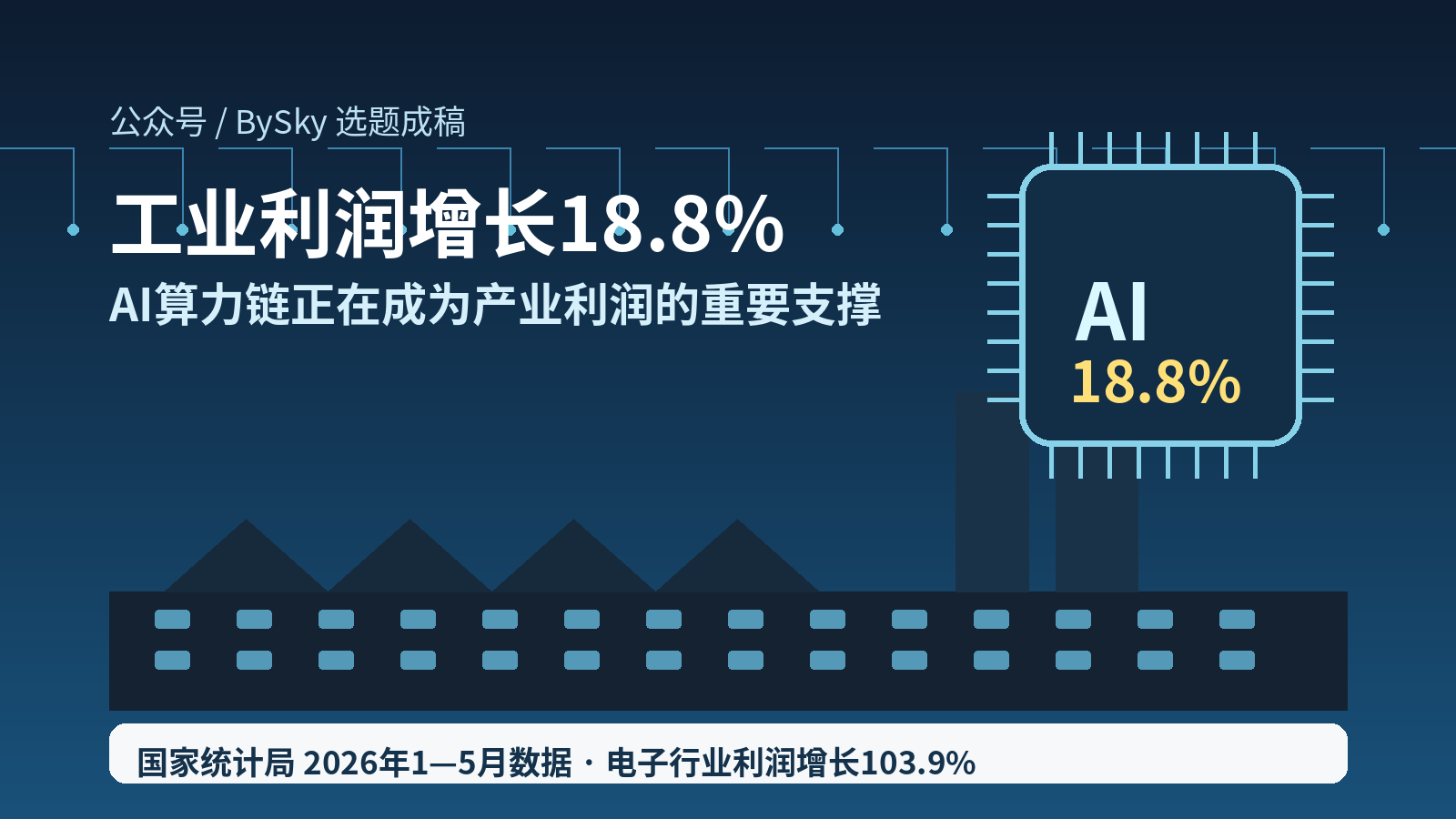
The 18.8% figure is about both scale and efficiency
The headline number is strong: total profits of major industrial firms reached 3.14396 trillion yuan from January to May, up 18.8% year on year. Manufacturing profits reached 2.32852 trillion yuan, up 20.0%.
The efficiency indicators are also worth noting. For every 100 yuan of operating revenue, industrial firms incurred 84.95 yuan in costs, 0.59 yuan lower than a year earlier. The operating profit margin stood at 5.56%, up 0.63 percentage points.
This suggests that profit growth is not just about revenue expansion. It also reflects cost efficiency, product mix optimization, and the emergence of higher-value manufacturing links.
Why electronics profits are connected to AI computing
The most striking data point is the 103.9% profit growth in the electronics industry — computer, communications, and other electronic equipment manufacturing. According to the government report, electronics contributed 43.1% to overall industrial profit growth, as the global AI boom increased demand for high-end computing and memory products.
The transmission mechanism is straightforward. AI models require training and inference capacity. Computing capacity requires chips, servers, memory, optical communication modules, power systems, and cooling. These hardware needs then flow into electronic components, specialty materials, circuits, and equipment manufacturing.
In other words, when AI applications grow, the infrastructure behind them grows as well. That infrastructure eventually shows up in industrial orders and profit margins.
AI profits are not concentrated only in model companies
If we look only at AI apps, we may mistake AI for a software race. The industrial data tells a more layered story.
First, demand is created by large models, enterprise AI systems, agents, and data centers. Second, this demand moves into computing chips, memory, servers, networking, power, and thermal management. Third, it reaches manufacturing links such as electronic components, specialty materials, circuits, advanced packaging, and equipment. Fourth, it supports parts of the materials and energy infrastructure needed to sustain AI-scale computing.
The numbers reinforce this view: high-tech manufacturing profits rose 44.7%; optoelectronic device manufacturing and discrete semiconductor device manufacturing profits rose 53.8% and 40.6%, respectively; electronic specialty materials manufacturing surged 665.4%. Non-ferrous metals smelting and processing profits grew 117.1%.
AI’s economic value is therefore being distributed across a chain: computing, hardware, manufacturing, materials, and energy. Whoever controls a critical link in this chain is better positioned to capture real returns from the AI wave.
What readers should watch: follow the profit path
For investors, builders, and policy observers, the key lesson is that AI should not be judged only by application popularity or model rankings. The more important question is where profits are actually landing.
Five indicators are worth tracking: data center and computing infrastructure investment trends; demand stability for high-end computing, memory, and optical communication products; whether orders in electronic materials, circuits, and advanced packaging are forming a sustained base; whether power, energy storage, and cooling infrastructure are keeping pace; and whether corporate financial indicators such as margins, inventory turnover, and receivables are aligned.
The most useful AI research question is no longer “Which model is the smartest?” It is: “Where does AI demand become industrial revenue and profit?”
For industrial policy: AI opportunity includes the support chain
From an industrial policy perspective, AI opportunity is not limited to building large models. It also includes building the industrial support system that allows AI to scale: electronics manufacturing, data center infrastructure, green power, storage, cooling, components, and specialized materials.
For local economies, this means AI-related development should be connected to real industrial capacity: specific orders, production lines, supply chains, energy systems, and skilled workers. The goal is not to chase slogans, but to translate AI demand into practical projects and measurable productivity.
In that sense, AI becomes more than a technology theme. It becomes a manufacturing, infrastructure, and productivity theme.
AI’s next stage is industrial
The January-May industrial profit data offers a useful way to think about AI. AI is entering the real economy through electronics, high-tech manufacturing, materials, power systems, and infrastructure.
When electronics profits rise 103.9%, when high-tech manufacturing profits rise 44.7%, and when specialty electronic materials show rapid growth, we are seeing the early shape of AI demand moving through manufacturing.
The next stage of AI should be evaluated not only by model releases or app downloads, but by supply chains, infrastructure, productivity, and profit transmission. In the end, the most durable AI story is the one that moves from screens to factories, from traffic to orders, and from concept to the profit statement.

Claude Sonnet 5 Shows the New AI Race Is About Default Workflows
The next moat may be the place a model occupies in daily work, not only its benchmark score.

ChatGPT Adoption Shows AI Is Becoming a Daily Global Utility
OpenAI data reveals that users send 50% more messages after 6 months, non-English speakers now make up the majority of active users, and the number of distinct use cases per user has doubled — signaling ChatGPT is moving from a novel chatbot to a daily global utility.

AI Agents Are Moving From Chat to Delegated Work
OpenAI research shows 80.6% of Codex users have delegated tasks exceeding 30 minutes of human work. The age of AI-as-chatbot is giving way to AI-as-delegated-worker, and the implications extend far beyond software engineering.